Contents
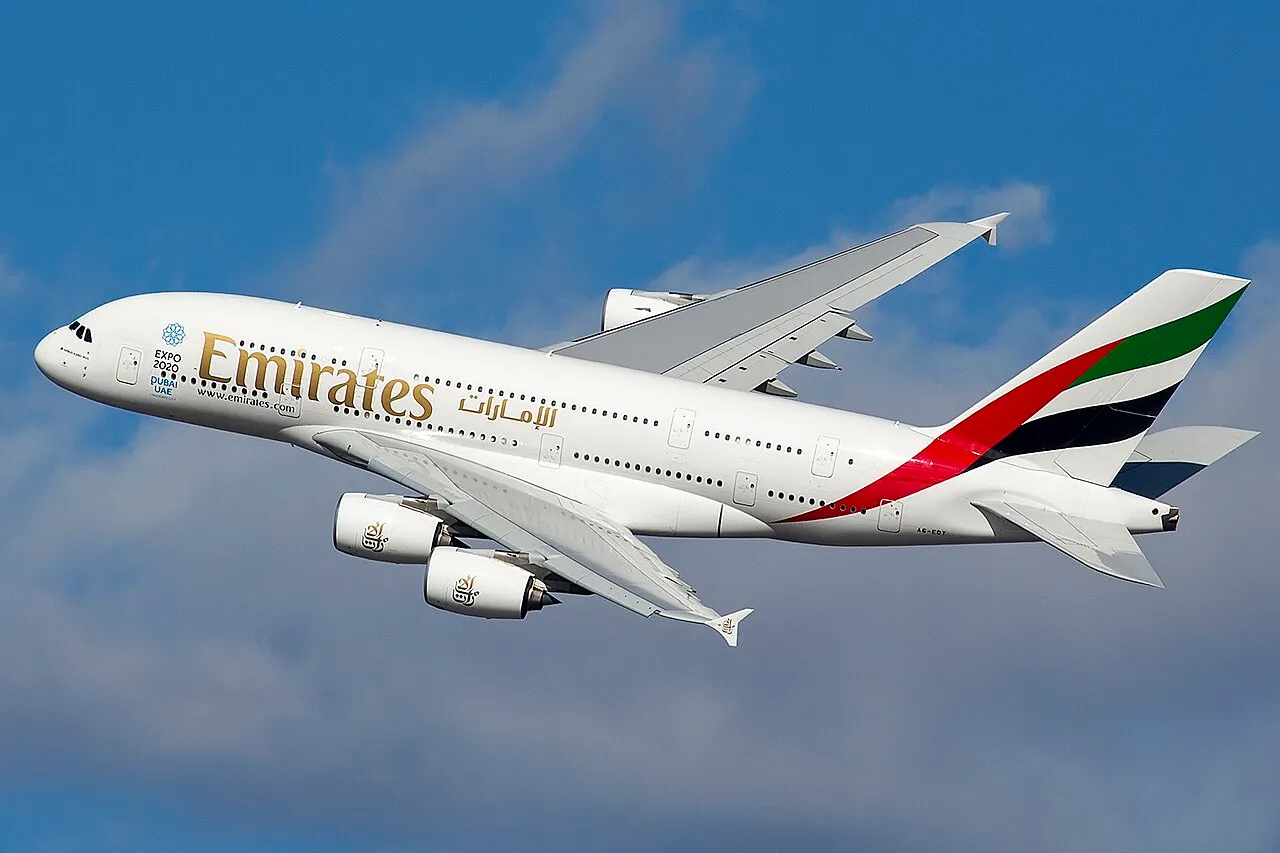
The Airbus A380 is the largest passenger plane ever built and the only full-length double-deck airliner. Airbus designed it to serve more passengers on long-haul routes between major airports. Production has ended, but as of 2026 the type still flies with a group of large international airlines, and Airbus calls it a passenger favourite1.
Design and development
Airbus began studies in 1988 and announced the project in 1990 to challenge the dominance of the Boeing 747 on long-haul routes. The design, then called the A3XX, was presented in 1994, and Airbus launched the A380 programme on 19 December 2000. The first prototype was unveiled in Toulouse on 18 January 20052 and made its maiden flight on 27 April 20051, and the type received its EASA type certificate on 12 December 20063.
The programme was not smooth. Problems with the electrical wiring2 delayed initial production by two years, and development costs almost doubled. Technically the A380 set precedents: Airbus says it was the first aircraft its engineers designed with a full digital mock-up1, and it used carbon fibre reinforced plastic parts that were later adopted on the A350.
Specifications
The A380 is 73 metres long and 24 metres high, with a wingspan of 79.8 metres. Its two passenger decks have a combined floor area of 550 square metres1. The wingspan is a compromise: the wing was built for a maximum take-off weight above 600 tonnes to allow larger versions, and its optimal span would be about 90 metres, but airport limits of 80 metres2 forced a longer chord instead.
EASA’s type certificate lists fifteen weight variants, with maximum take-off weights from 480 to 575 tonnes. Typical seating is 525 passengers, and the same certificate approves it for 868 passengers in an emergency evacuation3, 330 on the upper deck and 538 on the main deck. Its range is about 8,000 nautical miles (14,800 km), roughly 17 hours of flight. It is powered by four Rolls-Royce Trent 900 or four Engine Alliance GP7000 engines. Airbus puts its fuel use at about 3.1 litres per 100 passenger-kilometres1, and its design cruise speed is Mach 0.852.
The A380 is pressurised to the equivalent of 1,520 m at cruising altitudes up to 12,000 m, and Airbus points to a wider cabin, wider seats and more headroom1, LED mood lighting and a change of cabin air every 2 to 3 minutes. Airlines used the space in different ways: Singapore Airlines introduced partly enclosed first-class suites in 2007, Qantas added a sofa lounge on the upper deck a year later, and Emirates began offering shower spas2 for first-class passengers in late 2008.
Variants
Only one passenger model, the A380-800, was built, in three versions that differ by engine3: the A380-841 and A380-842 with Rolls-Royce Trent 900 engines and the A380-861 with Engine Alliance GP7000 engines. A stretched A380-900 was planned for about 650 passengers in a standard layout, but Airbus postponed its development in May 20102.
Operators and service
The first aircraft was delivered to Singapore Airlines on 15 October 2007 and entered service on 25 October. Emirates was the second airline to receive the type2 and started flying it between Dubai and New York in August 2008. In all, 251 A380s were delivered to 14 customers, and Emirates is the largest operator. Other airlines Airbus lists as operating the type include All Nippon Airways, British Airways and Qantas1, along with Asiana, Etihad, Korean Air, Lufthansa, Qatar Airways and Singapore Airlines.
Production peaked at 30 aircraft a year in 2012 and 2014 and ended in 2021. The final A380 made its first flight on 17 March 2021 and was delivered to Emirates on 16 December 2021, the 251st A380 Airbus delivered4. Airbus says operators will keep receiving its support and services for decades. The fleet has shrunk since its peak: as of April 2024, there were 189 aircraft in service with 10 operators worldwide, and of its fifteen total operating airlines, five had fully retired2 the type. As of 2026, where it still flies, it mainly serves long-haul routes between major airports; Emirates, for example, flies it from London to Perth via Dubai1.
Safety record
Airbus says the type has flown more than 800,000 flights and carried over 300 million passengers4. By December 2021 that total stood at more than 7.3 million block hours, with no fatalities and no hull losses. The type has had two notable accidents, both uncontained engine failures with no injuries: Qantas Flight 32 in November 2010, which forced an emergency landing back in Singapore, and Air France Flight 66 in September 20172, which diverted safely to Goose Bay, Canada.
Similar aircraft
- Boeing 747-8: the final version of the 747, the jumbo jet Airbus set out to challenge; Boeing says the 747-8 designation marks the technology it shares with the 787 Dreamliner, and it is marked by its distinctively recognizable hump5 rather than the A380’s full-length double deck2.
- Boeing 777X: powered by GE9X engines, its 777-9 seats 375 to 450 in two-class layout6, well short of the A380’s typical 525.