Contents
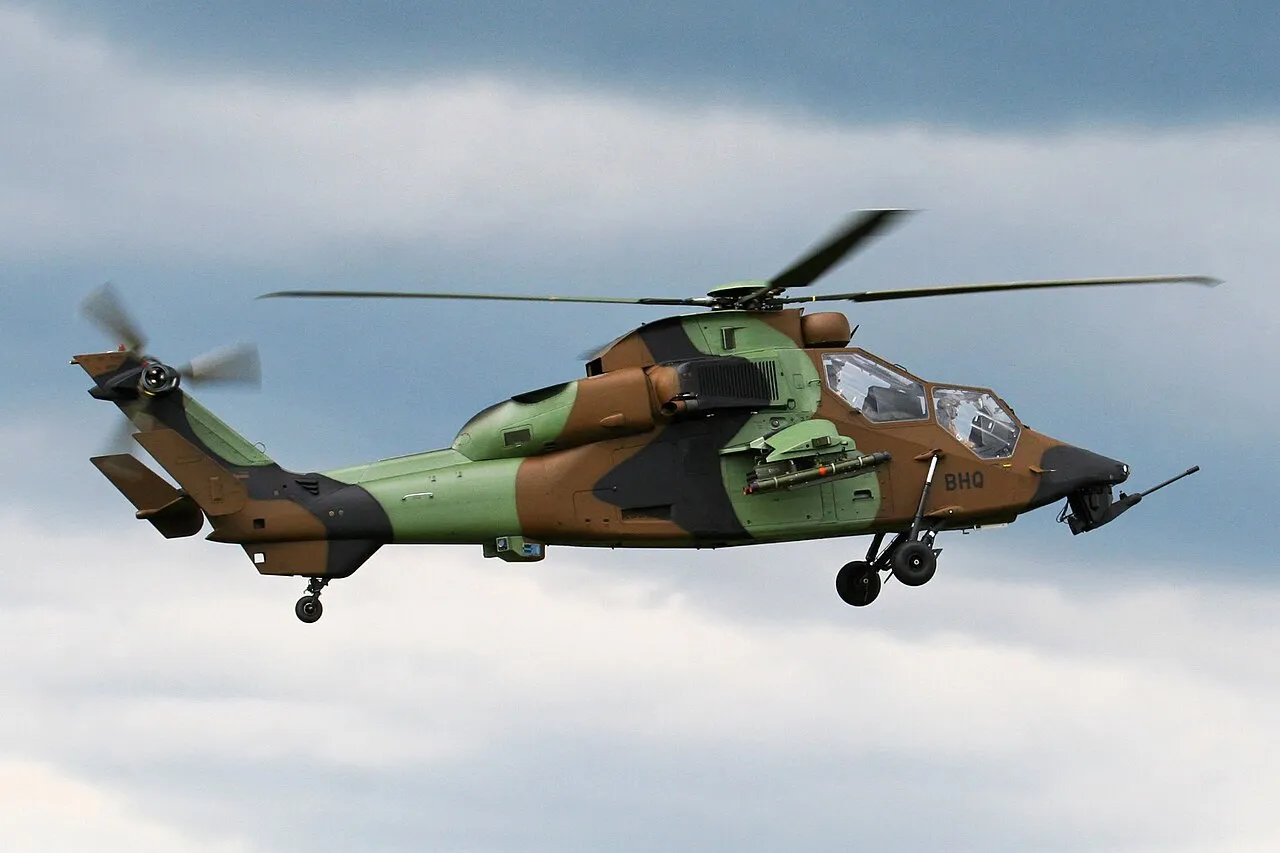
The Eurocopter Tiger is a twin-engine attack helicopter developed jointly by France and Germany and built by Eurocopter, now Airbus Helicopters. It is designed for anti-tank and escort missions, and several export customers fly it alongside the two founding air arms. The type first flew on 27 April 1991 and remains in service1 today.
Design and development
Development began with a Franco-German requirement for an advanced anti-tank helicopter issued in 1984; the two countries initially planned to buy 427 helicopters between them, with West Germany wanting 212 of an anti-tank PAH-2 version and France 75 close air-support HAP “Gerfaut” and 140 anti-tank HAC “Tigre” models. The programme nearly collapsed: it was effectively cancelled in 1986 as costs spiralled, then formally relaunched in November 1987 under contracts that shifted more financial risk onto the manufacturers. On 18 June 1999, France and Germany placed firm orders for an initial batch of 160 Tigers, 80 each, worth €3.3 billion; by 2008 the programme’s overseer OCCAR put the total cost at €7.3 billion1.
The first prototype flew on 27 April 1991, and the first production aircraft was rolled out at Eurocopter’s Donauwörth factory on 22 March 2002, but it took until 2005 before either founding air arm received one: the French Army took delivery on 18 March 2005, followed by Germany on 6 April 20051.
The Tiger was the first all-composite helicopter developed in Europe, its fuselage built from 80% carbon-fibre-reinforced polymer and kevlar, 11% aluminium and 6% titanium. That fuselage is armoured to withstand small-arms fire and 23 mm cannon rounds, and the design also minimises visual, radar, infrared and acoustic signatures. The crew of two sit in tandem, the pilot in the forward seat and the weapon systems officer behind, working a tandem-seat glass cockpit with EUROGRID battlefield management and map displays, integrated HF/VHF/FM radio and satellite communications, a high-authority digital automatic flight control system and redundant MIL 1553 data buses1.
The helicopter is powered by two MTR390 turboshaft engines built jointly by MTU, Turbomeca and Rolls-Royce under FADEC control, with the upgraded MTR390-E, giving 14% more power, fitted to later variants. A mast-mounted Osiris sight above the main rotor hub combines optical and thermal cameras with a laser range finder, designator and tracker, stabilised by multiple gyroscopes, letting the crew search for and designate targets while keeping the fuselage low. Depending on variant it carries a nose-mounted 30 mm cannon turret, external gun pods, anti-tank missiles and up to four launchers for 70 and 68 mm rockets on its stub wings1.
Specifications
Its fuselage is 13.85 metres long from nose to tail, and its main rotor spans 13 metres rather than a fixed wing, as on any helicopter. Maximum take-off weight is 6,600 kg. Its combat range, flying armed with standard fuel tanks, is 740 km, extending to 1,130 km unarmed with external tanks. At maximum take-off weight and sea level, cruise speed is 271 km/h1.
Variants
The two founding nations each ordered a different standard. Germany flies the UHT, a support-helicopter version with a mast-mounted sight and a limited anti-tank role; an agreement between Berlin and Eurocopter in March 2013 cut the German order to 57 aircraft and renamed the type from UHT to KHT that October. France and Spain operate the HAP escort and close air-support model with a roof-mounted sight and a 30 mm chin turret; France took 40 HAPs, delivered by 2012 at around €27 million each, though the HAP is being phased out of French service from 2026. The later HAD, with the enhanced engine, stronger ballistic protection and a multirole weapons fit, was estimated at US$44-48 million per aircraft in 2011; France ordered 40 HADs in December 2004 and Spain ordered 24. Australia took its own ARH variant, with upgraded engines and a laser designator for Hellfire II missiles, ordering 22 of them in December 20011.
The Tiger also lost out in several export contests: a €6.9 billion deal to sell Saudi Arabia 12 Tigers, signed in July 2006, was cancelled in late 2007, and it lost a South Korean contract for up to 20 attack helicopters to the Boeing AH-64 in April 2013, after also failing to win Indian trials from May 20071.
Operators and service
The type has been produced since 1991, with 175 built as of April 2026. France, Germany and Spain fly the type, and all three have sent it into combat. France’s Tigers serve with three Army regiments: the 1st Combat Helicopter Regiment, the 4th Special Forces Helicopter Regiment and the 5th Combat Helicopter Regiment; the type’s first combat deployment sent three French HAPs of the 5th Helicopter Regiment to Kabul in July 2009, and by July 2010 the Afghan detachment had logged 1,000 operational hours. France also flew the Tiger in combat over Libya from 4 June 2011, alongside British Army Apaches, and deployed it to Mali from January 2013. Germany’s Tigers fly with Army Aviation Helicopter Regiment 36 and are due to leave service by 2032; Germany deployed to Afghanistan from December 2012, flying 1,860 hours over 260 sorties between 30 January 2013 and 30 June 2014 and firing its first shots in combat there on 4 May 2013, before rotating Tigers into Mali in support of the UN mission MINUSMA from March 2017. Spain’s Attack Helicopter Battalion 1 sent its Tigers to Afghanistan in March 2013. Australia also flew the type, mostly with the 1st Aviation Regiment at Robertson Barracks in Darwin; it took delivery of its last ARH in December 2011, reached final operating capability in April 2016, and retired the type on 30 September 20261.
Safety record
A German Tiger deployed to Mali crashed on 26 July 2017, killing both pilots1, while the type was supporting the MINUSMA peacekeeping mission there.
Similar aircraft
- Boeing AH-64 Apache: the American attack helicopter the Tiger is most often compared with, built to a similar anti-tank and escort role.
- Mil Mi-28: a Russian attack helicopter of the same generation, designed for the same tank-busting mission.
- Mil Mi-24: an older Soviet-era attack helicopter the Tiger’s generation was designed to counter in Europe.
_ZVY5TD.webp)
_Z1SYJMK.webp)
_approaching_JFK_Airport_1b71Hs.webp)
_(cropped)_Z2qDRzS.webp)