Contents
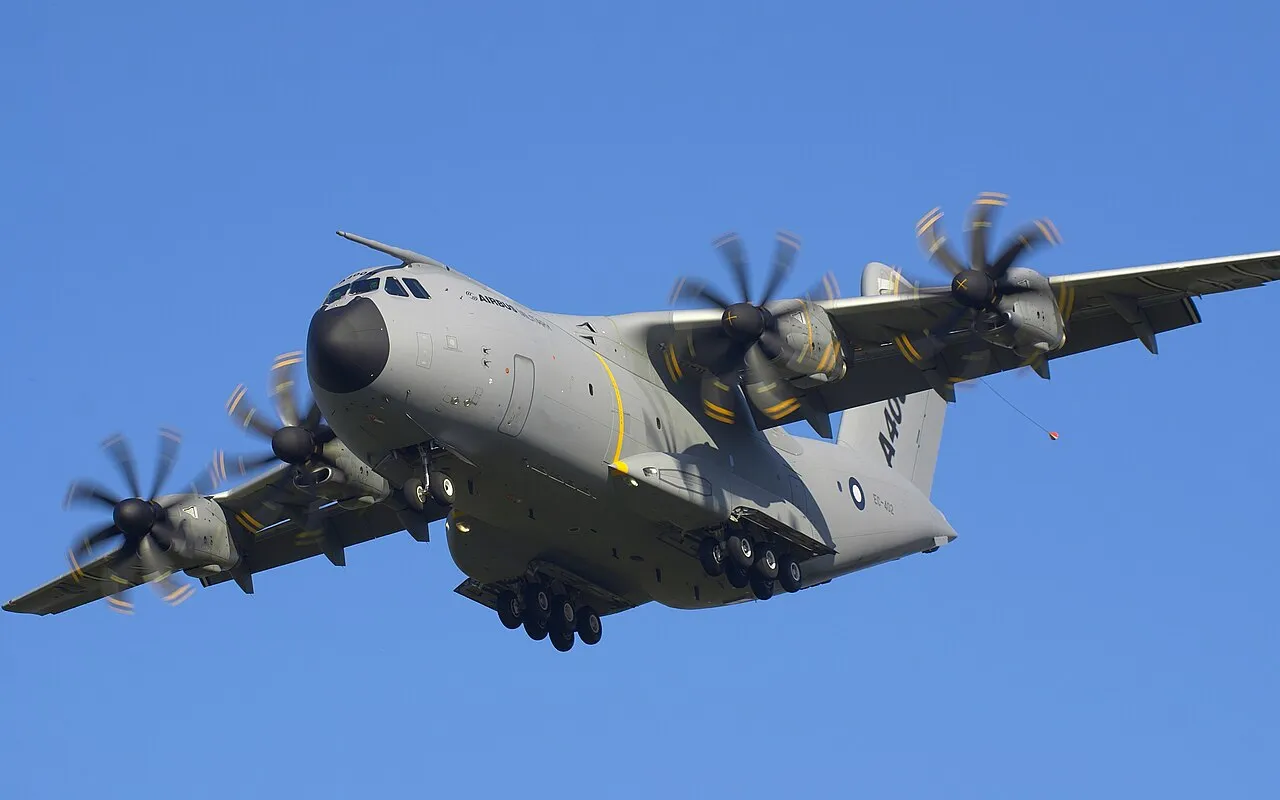
The Airbus A400M Atlas is a military transport aircraft built to carry troops and cargo over both tactical short-field missions and long strategic distances, a role earlier designs split between separate aircraft types. Airbus Defence and Space developed and builds it for a group of European and allied air forces1. It is in service2 with several operators today.
Design and development
The A400M grew out of a long-running European effort to replace ageing tactical transports such as the Transall C-160 and Lockheed C-130 Hercules with a single new type, and Airbus flew the first prototype on 11 December 2009. Unlike most large military airlifters, which use turbofan or turbojet engines, the A400M is powered by turboprops2, a choice that favours short, rough-field performance and fuel efficiency over outright speed.
The programme ran years late and well over budget, with the partner nations and Airbus repeatedly renegotiating costs and delivery schedules; by 31 January 2025, 130 aircraft had been delivered out of an order book that has shrunk since the type was launched, and production has continued since 20072.
Specifications
The A400M is 45.1 metres long with a wingspan of 42.4 metres and a maximum take-off weight of 141,000 kg. It is powered by four Europrop TP400-D6 turboprop engines rated at 8,250 kW each, among the most powerful turboprops ever put into series production, and cruises at around 781 km/h. Its ferry range is about 8,700 km, falling to roughly 3,300 km when carrying its maximum payload of 37 tonnes. A typical crew is two pilots and one loadmaster, with room for an optional third crew member. France’s 2013 defence budget calculated a unit cost of about €152.4 million per aircraft2.
Variants
Airbus has so far built the A400M as a single production standard for its military customers, with incremental software and capability upgrades delivered over the life of the programme rather than as distinct named variants; the aircraft’s tactical and strategic roles are instead built into the one airframe1 rather than split across separate models, in contrast to how some rival transports are offered in short- and long-fuselage versions.
Operators and service
The A400M flies with the air forces of the European partner nations that launched the programme and with several export customers; Airbus describes the type as in service1 and continuing to be delivered, with 130 aircraft handed over by the end of January 20252.
Safety record
On 9 May 2015 an A400M on a pre-delivery test flight crashed shortly after take-off from Seville, Spain, killing four of the six crew on board. Investigators found that engine control software files had been wiped during production, which left three of the four engines’ power frozen and stuck at idle, unresponsive to throttle commands, in flight2, a fault traced to a data-handling error in the final assembly line rather than a design flaw in the aircraft itself.
Similar aircraft
- Lockheed C-130 Hercules: the long-serving tactical airlifter the A400M was designed partly to succeed, smaller and shorter-ranged but able to use even rougher strips.
- Boeing C-17 Globemaster III: a larger, jet-powered strategic airlifter that overlaps with the A400M’s heavier missions.
- Ilyushin Il-76: a Soviet-designed jet transport of broadly similar size and role, built for comparable short-field military airlift.
_ZVY5TD.webp)
_Z1SYJMK.webp)
_approaching_JFK_Airport_1b71Hs.webp)
_(cropped)_Z2qDRzS.webp)