Contents
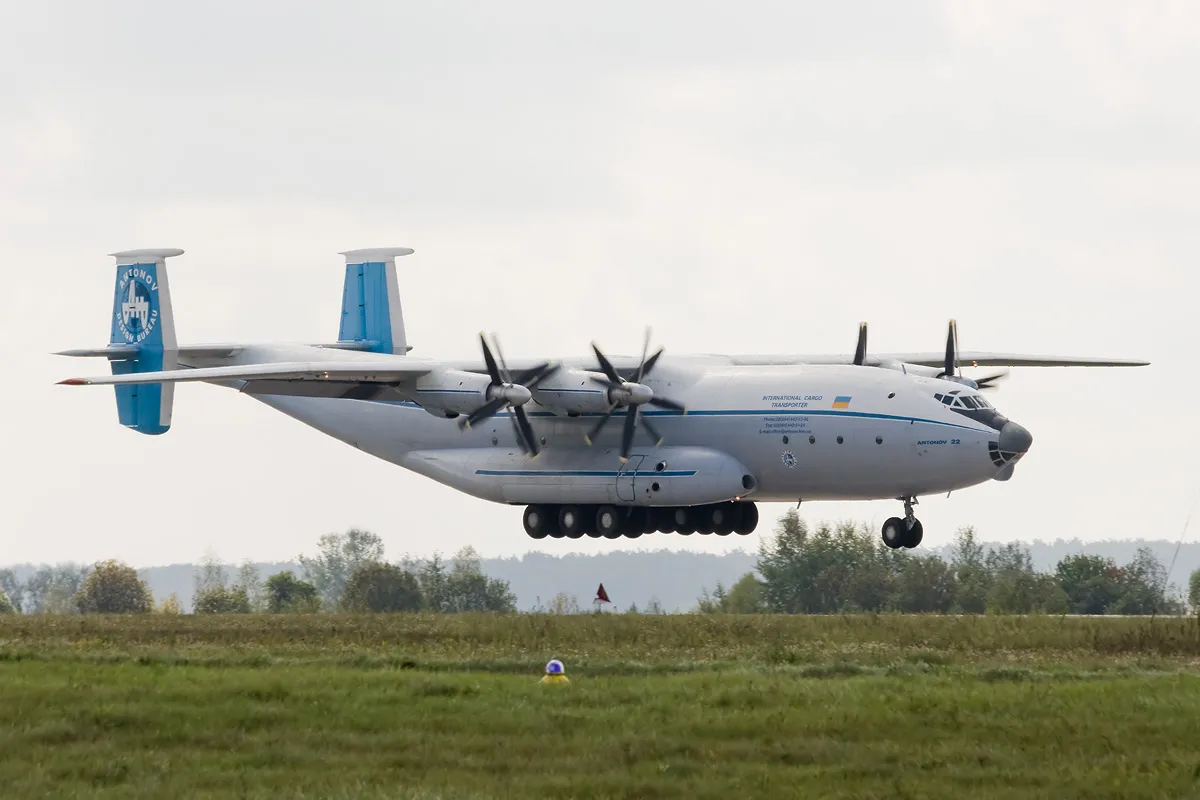
The Antonov An-22 Antei is a retired heavy turboprop military transport developed by the Antonov Design Bureau and produced by the Tashkent State Aircraft Factory in the Soviet Union; NATO gave it the reporting name “Cock”. Until the C-5 Galaxy arrived it was the world’s largest aircraft2. The Soviet military especially valued its ability to carry outsized loads3, from complete missile systems to large and heavy military vehicles. Its service ended when the last operational aircraft crashed during a test flight in December 20251.
Design and development
The requirement dates to the late 1950s, when the Soviet military wanted a large strategic airlifter to supplement the smaller An-8 and An-12. The Ministry of Defense sought an airlifter that could transport outsized cargo, including intercontinental ballistic missiles and military vehicles that had until then gone by rail. Its hold had to take no fewer than four BMD-11 armoured vehicles, where the An-12 could carry only one.
Antonov built a wooden mock-up in Kyiv, known internally as the Model 100 and first designated An-20. The result was essentially an enlarged An-122, except that the tail was redesigned with twin vertical fins. The first prototype was rolled out on 18 August 1964, and it flew on 27 February 1965, at which point it was the world’s heaviest aircraft. After four months of test flying it was shown at the 1965 Paris Air Show1. In all, 68 An-22s were completed, including two prototypes, between 1966 and 19763.
Specifications
The An-22 is 57.90 m long with a wingspan of 64.40 m, and its maximum take-off weight is 250,000 kg. The high wing leaves room for a cargo space 33 m long with a usable volume of 639 m³2, and the maximum payload is 80,000 kg1. The hold had space for 151 paratroopers or 292 standard troops3 on two decks as an alternative to cargo.
Power comes from four Kuznetsov NK-12MA turboprops, the engine of the Tupolev Tu-95 bomber, each rated at more than 14,805 horsepower3 and driving eight-blade contra-rotating propellers more than 20 feet in diameter. Their slipstream over the wings, combined with large double-slotted flaps, lets the An-22 use relatively short runways for a plane of its size. The landing gear is built for rough airstrips, and the tire pressures can be adjusted in flight2 for the best landing performance.
Its maximum level speed is 740 km/h at altitude, with a cruise speed of 600 km/h. Range is 5,000 km with maximum payload and 10,950 km as a ferry flight. A pressurized forward fuselage has room for the crew and up to 28 passengers2; the cargo space is unpressurized, so the rear cargo doors can be opened in flight for paradrops. Over its career the type set 41 world records1 for speed, payload and payload-to-altitude.
Variants
- An-22: the initial production variant with an external start system, 37 built at Tashkent1.
- An-22A: an improved variant with air-start capability, a modified electrical system and updated radio and navigation equipment, 28 built at Tashkent1.
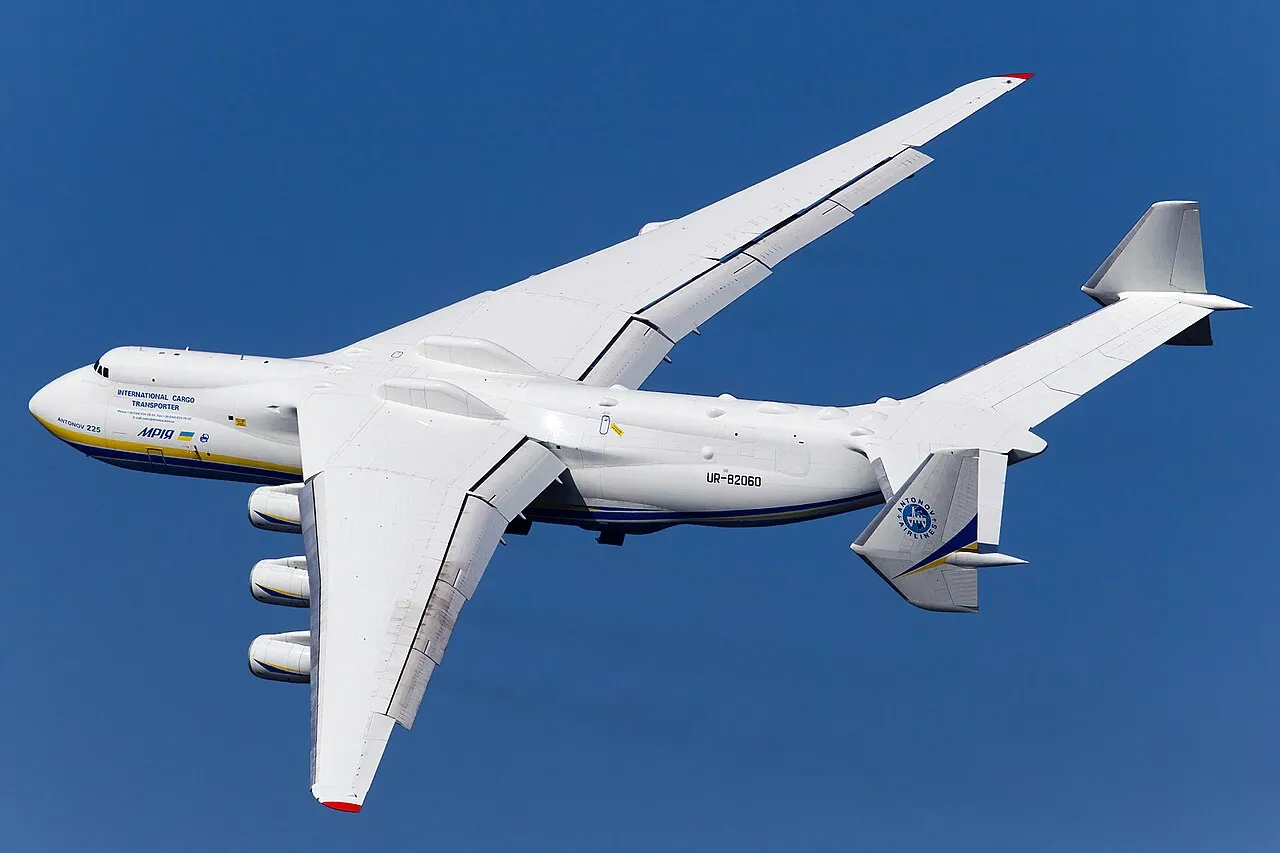
- Wing carrier: two An-22s were converted1 to carry wing centre sections or outer wings of the An-124 or An-225 above the fuselage, with a third centreline fin.
- Projects: a civil airliner for 724 passengers on two decks2 was proposed but not built, and an amphibian version never got past the scale model1.
Operators and service
Service with the Soviet military began in January 19693, and the civil airline Aeroflot also flew the type. An early task was Soviet humanitarian aid to Peru in July 1970 after the Ancash earthquake. An-22s delivered Soviet military aid to Egypt and Syria during the Yom Kippur War in 1973, to Angola in 1975 and to Ethiopia in 1977, and aircraft from Migalovo carried Soviet Airborne Troops in the 1979 invasion of Afghanistan1.
When the Soviet Union dissolved, most An-22s were on Russian territory and passed to the Russian forces, while a handful in Ukraine flew for the charter cargo operator Antonov Airlines. By the early 2000s the type’s career already looked nearly over, with just nine airworthy examples at Migalovo, outnumbered by the jet-powered An-124. Russia kept the type because it was cheaper to operate than the An-124 but had a much bigger hold than the Ilyushin Il-76. Antonov Airlines returned UR-09307 to service in September 20161, flew aid into Gao in Mali, and later used it for NATO’s SALIS charter programme. That aircraft, Ukraine’s last airworthy An-22, was reportedly damaged beyond repair at Hostomel Airport3 at the start of the full-scale Russian invasion.
In August 2024, reports said Russia had stopped flying its An-22s and that RF-09309 was being flown to Yekaterinburg for a museum. One An-22 is on display at the Technik Museum Speyer1 in Germany.
Safety record
One aircraft disappeared on 18 July 1970 during the Peru relief flights, losing radar contact 47 minutes after take-off from Keflavík in Iceland. Another was shot down at take-off near Kabul on 28 October 1984, probably by an SA-7 missile. RA-09343 of the Russian Air Force crashed on a positioning flight from Voronezh to Migalovo, killing all twelve crew1; it had been stored since 2001 and returned to flying condition in January 2010.
The last operational An-22 crashed in the Ivanovo region on 9 December 20251. Russian state media quoted the Ministry of Defense as saying it was on a test flight “following repairs”, and eyewitnesses reported it breaking apart in mid-air, with parts falling into a reservoir. TASS put the number on board at seven3, and Kommersant, citing anonymous sources, reported a likely technical malfunction.
Similar aircraft
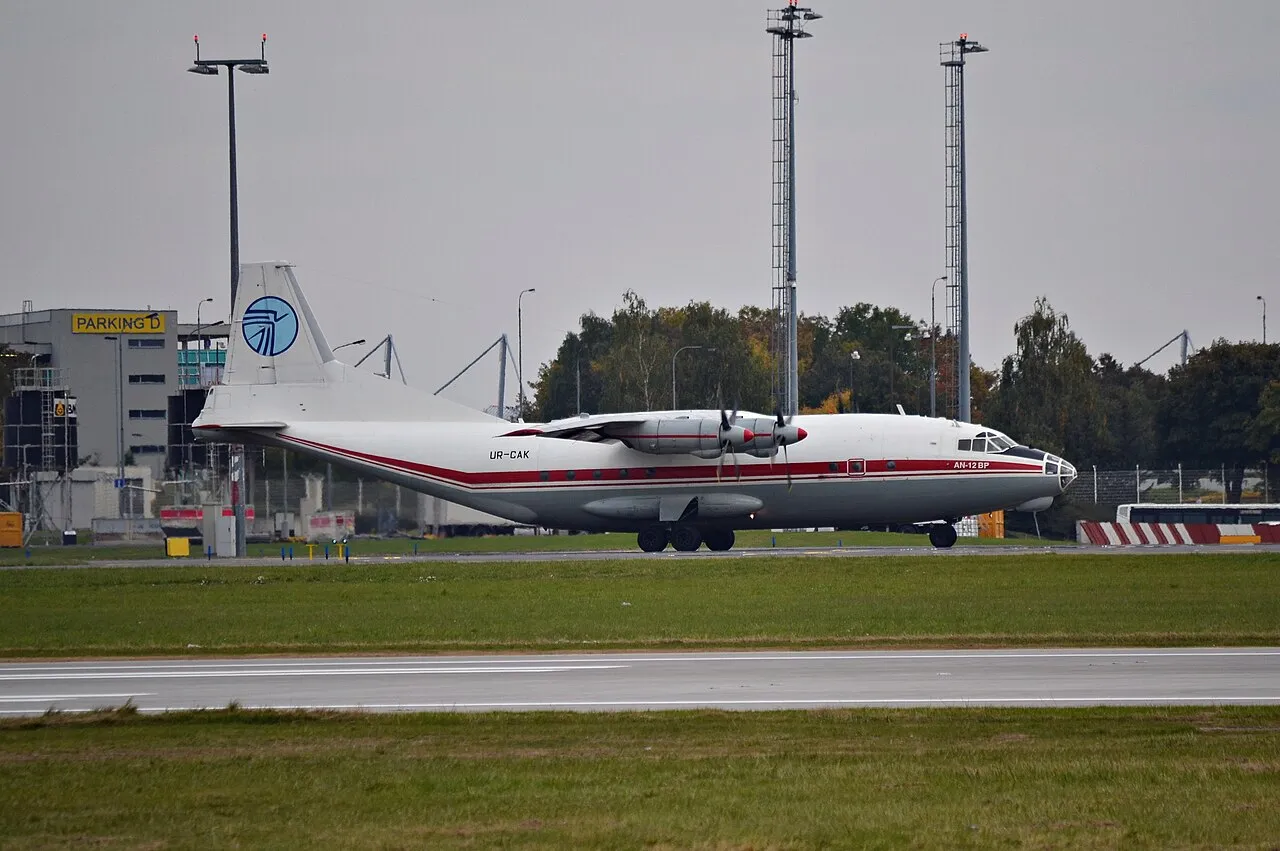
- Antonov An-12: the smaller predecessor; the An-22 is essentially an enlarged An-122 with a redesigned twin-fin tail.
- Antonov An-124 Ruslan: the far more capable, jet-powered3 successor, which entered service in the 1980s as the world’s heaviest production transport.
- Ilyushin Il-76: the Russian transport the An-22 outclassed with a much bigger hold3.
- Lockheed C-5 Galaxy: the airlifter whose arrival ended the An-22’s time as the world’s largest aircraft2.
- Tupolev Tu-95: the bomber that shares the An-22’s four Kuznetsov NK-12MA turboprops3.