Contents
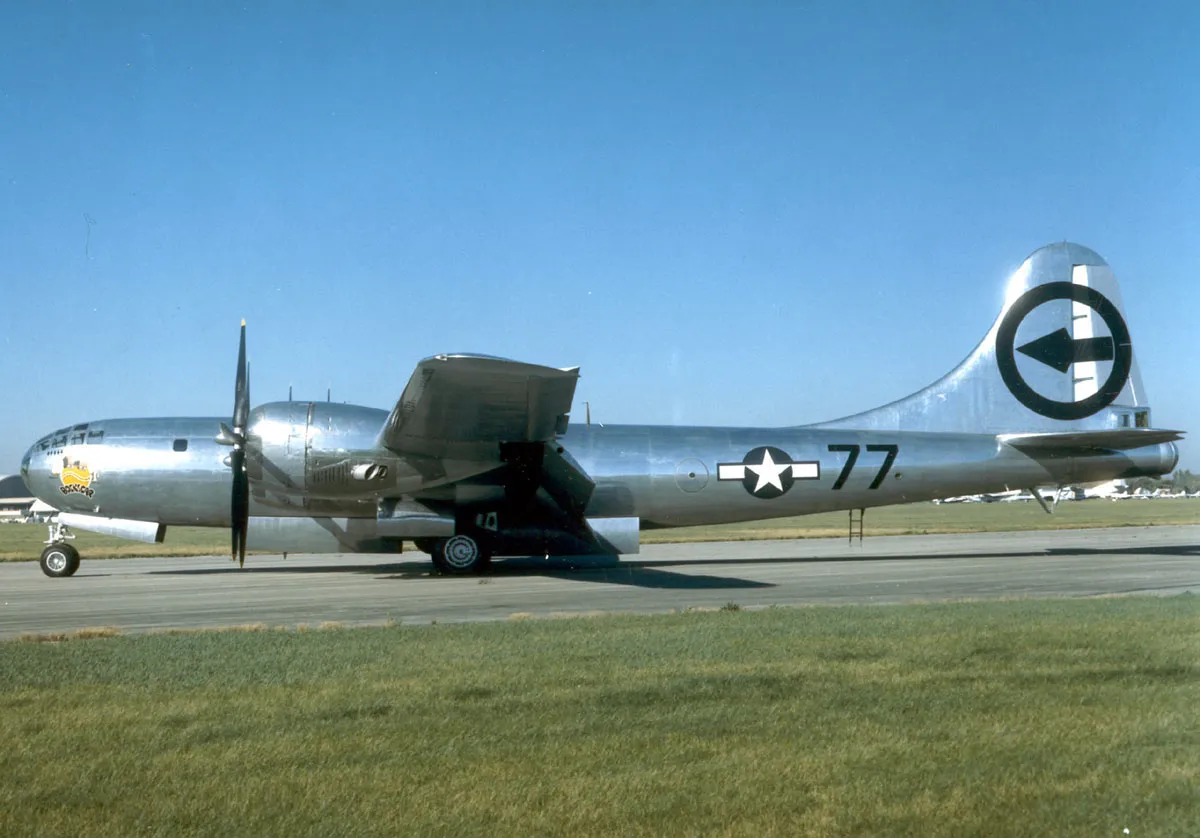
The Boeing B-29 Superfortress is a four-engine heavy bomber that the United States Army Air Corps specified in December 1939, calling for an aircraft able to carry 20,000 pounds of bombs some 2,667 miles at 400 mph. Boeing built it to carry the war to Japan from bases far beyond the range of existing bombers, and it became the aircraft that carried out the firebombing of Japanese cities and dropped the only two atomic bombs used in combat. Production ended in 1946, but two restored examples still fly on the airshow circuit1.
Design and development
Boeing had been studying “superbomber” designs since 1938, and its Model 345 won the Army’s competition, with prototype orders placed on 24 August 1940. The first prototype made its first flight on 21 September 1942, and a second prototype crashed on 18 February 1943, killing test pilot Edmund T. Allen and 31 others1.
The design broke new ground for an American bomber, with the first pressurised cabin fitted to an Allied production bomber, a dual-wheeled tricycle landing gear, and remote-controlled gun turrets aimed through analog computers. Four factories built the type, at Renton, Wichita, Marietta and Bellevue, at a programme cost that reached about $3 billion, more than the Manhattan Project1.
Early production aircraft were held back by unreliable Wright R-3350 engines: by late 1943 nearly 100 aircraft had been delivered but only 15 were airworthy. General Henry “Hap” Arnold intervened, and in the so-called Battle of Kansas, 150 aircraft were modified in five weeks during March and April 19441 to make them combat-ready.
Specifications
The B-29 is a four-engine, propeller-driven heavy bomber measuring 30.18 m in length with a wingspan of 43.05 m. It flew behind four Wright R-3350-23 Duplex-Cyclone 18-cylinder air-cooled turbosupercharged radial piston engines, giving a cruise speed of about 350 km/h and a maximum take-off weight of 60,555 kg. With a standard bomb load its range was about 5,230 km, extending to a 9,017 km ferry range without bombs. A typical crew numbered 11, and each aircraft cost around $639,188 in 1945 dollars1.
Variants
Besides the baseline model, Boeing built the B-29A-BN with a one-foot longer wingspan, and the B-29B-BA with reduced defensive armament to save weight. The nuclear-capable Silverplate aircraft had enlarged bomb bays, fuel injection and reversible propellers, with 65 airframes built through 1947; Enola Gay and Bockscar were among them. Reconnaissance, tanker and weather versions flew as the F-13/RB-29, KB-29 and WB-29, and the design was also the basis for the Boeing B-50 Superfortress, the C-97 Stratofreighter and the Boeing 377 Stratocruiser airliner1.
Four B-29s that made emergency landings on Soviet territory in 1944–45 were never returned; Stalin had Tupolev reverse-engineer the design instead, producing the Tupolev Tu-4, which first flew in 1947 and was built in 847 examples1.
Operators and service
The United States Army Air Forces flew the first B-29 combat mission on 5 June 1944, when 77 of 98 aircraft raided Bangkok, followed on 15 June 1944 by a raid on the Yawata Iron Works, the first attack on the Japanese home islands since the Doolittle Raid. Once bases on the Mariana Islands were ready, 111 B-29s of the 73rd Bomb Wing attacked Tokyo on 24 November 1944, opening a campaign of intensive incendiary raids on Japanese cities between February and August 1945, including the firebombing of Tokyo on the night of 9–10 March1.
The type’s best-known missions came that August: the Enola Gay dropped the “Little Boy” atomic bomb on Hiroshima on 6 August 1945, and Bockscar dropped “Fat Man” on Nagasaki on 9 August 1945; B-29s remain the only aircraft to have delivered nuclear weapons in combat1.
After the war, the Royal Air Force operated 87 loaned B-29s as the Washington B.1 between 1950 and 1954. In the Korean War the type flew about 20,000 sorties and dropped some 220,000 short tons of bombs between 1950 and 1953; daylight raids were switched to night missions after 28 B-29s were lost to Soviet-built MiG-15 jet fighters. Boeing’s production run ended on 28 May 1946 after 3,970 aircraft, and the US Air Force retired the last of the type from active duty on 21 June 1960. Today 22 aircraft survive in museums, including the airworthy FIFI and Doc1.
Safety record
The B-29’s biggest hazard in service was its own engines: the Wright R-3350 was prone to overheating and engine fires until the related Pratt & Whitney R-4360 arrived too late for wartime use. Two nuclear-related crashes followed the war: a B-29 carrying a nuclear bomb crashed near Kirtland Air Force Base on 11 April 1950, though its detonators meant no nuclear detonation was possible, and a B-29 carrying a Mark 4 bomb crashed at Fairfield-Suisun Air Force Base on 5 August 1950, killing 19 people. In the Korean War, the US lost 78 B-29s, 57 of them in action1.
Similar aircraft
- Boeing B-17 Flying Fortress: Boeing’s earlier four-engine heavy bomber of World War II, the B-29’s wartime stablemate in the US bomber fleet1.
- Boeing B-52 Stratofortress: the long-range jet bomber that succeeded the piston-engine Superfortress generation in US strategic service1.
- Tupolev Tu-4: the Soviet reverse-engineered copy of the B-291.
_ZbySau.webp)
_ZnEDr2.webp)