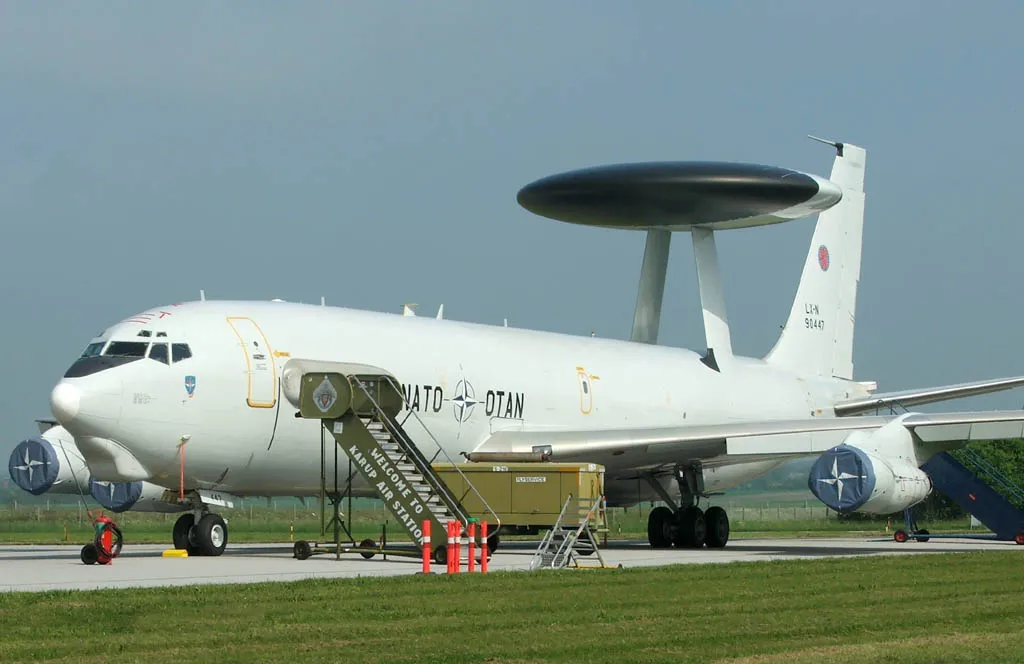
The Boeing E-3 Sentry is an airborne warning and control system (AWACS) aircraft built by Boeing Defense, Space & Security1. It carries a rotating radar dome above its fuselage to track aircraft and ships over a wide area and to direct fighters and other forces from the air. Air forces use it as a mobile command post that can see further and react faster than ground-based radar, which is why the United States, NATO and several allied air forces have flown it since the late 1970s.
Design and development
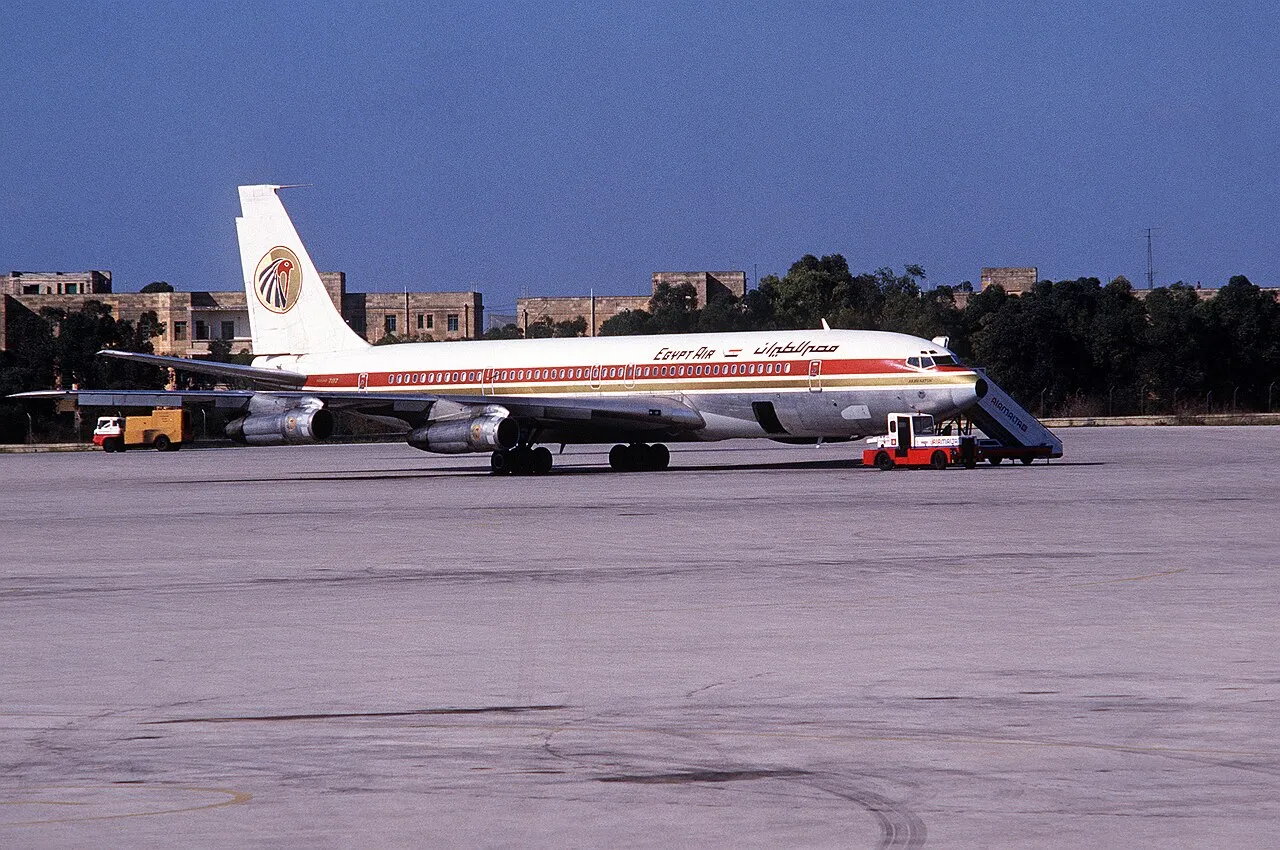
The E-3 grew out of the US Air Force’s search for a successor to earlier airborne early-warning aircraft, and Boeing built it on the airframe of its 707-320B commercial airliner. The prototype, designated EC-137D, first flew on 9 February 1972, and the production version that followed it, the E-3 Sentry, made its first flight on 25 May 19761. The defining feature is the rotating radar dish mounted on struts above the rear fuselage, which gives the type its unmistakable silhouette and its ability to scan the sky and surface well beyond the range of ground radar.
Specifications
The E-3 is 46.61 metres long with a wingspan of 44.42 metres, close to the dimensions of the 707 airliner it is based on. Its maximum take-off weight is 157,397 kg, and it cruises at about 580 km/h. Unrefuelled, it has a range of about 7,400 km, which can be extended with air-to-air refuelling. Power comes from four Pratt & Whitney TF33-PW-100A turbofans, each rated at 21,500 lbf of thrust; some upgraded variants flown by other operators use CFM56-2 engines instead. A crew of four flies the aircraft, with a further 13 to 19 mission specialists working the radar and communications systems depending on the variant1.
Variants
Boeing and its customers built several versions of the E-3 for different air forces, mainly differing in radar processing systems, engines and mission equipment, rather than in the basic airframe. The United States, NATO, France, the United Kingdom, Saudi Arabia and Chile all received their own configurations, and later US and NATO aircraft were progressively upgraded with newer radar and communications systems while keeping the original Pratt & Whitney engines; other operators adopted the CFM56-2 engine upgrade on their fleets.
Operators and service
A total of 68 E-3s were built between 1977 and 1992. The type remains in service with the United States, NATO, France, Saudi Arabia and Chile; the United Kingdom flew it until it retired its fleet in 20211. Decades of operational use have made it a familiar sight at NATO air bases in Europe, where NATO-owned aircraft fly under alliance markings rather than those of a single member state.
Similar aircraft
- Northrop Grumman E-2 Hawkeye: a smaller, carrier-capable AWACS aircraft built for the US Navy, performing a similar early-warning role from a very different airframe.
- Boeing E-767: a later AWACS conversion of the Boeing 767 airliner, built for Japan as a successor concept to the E-3’s own 707-based design.
_ZbySau.webp)



_ZnEDr2.webp)