Contents
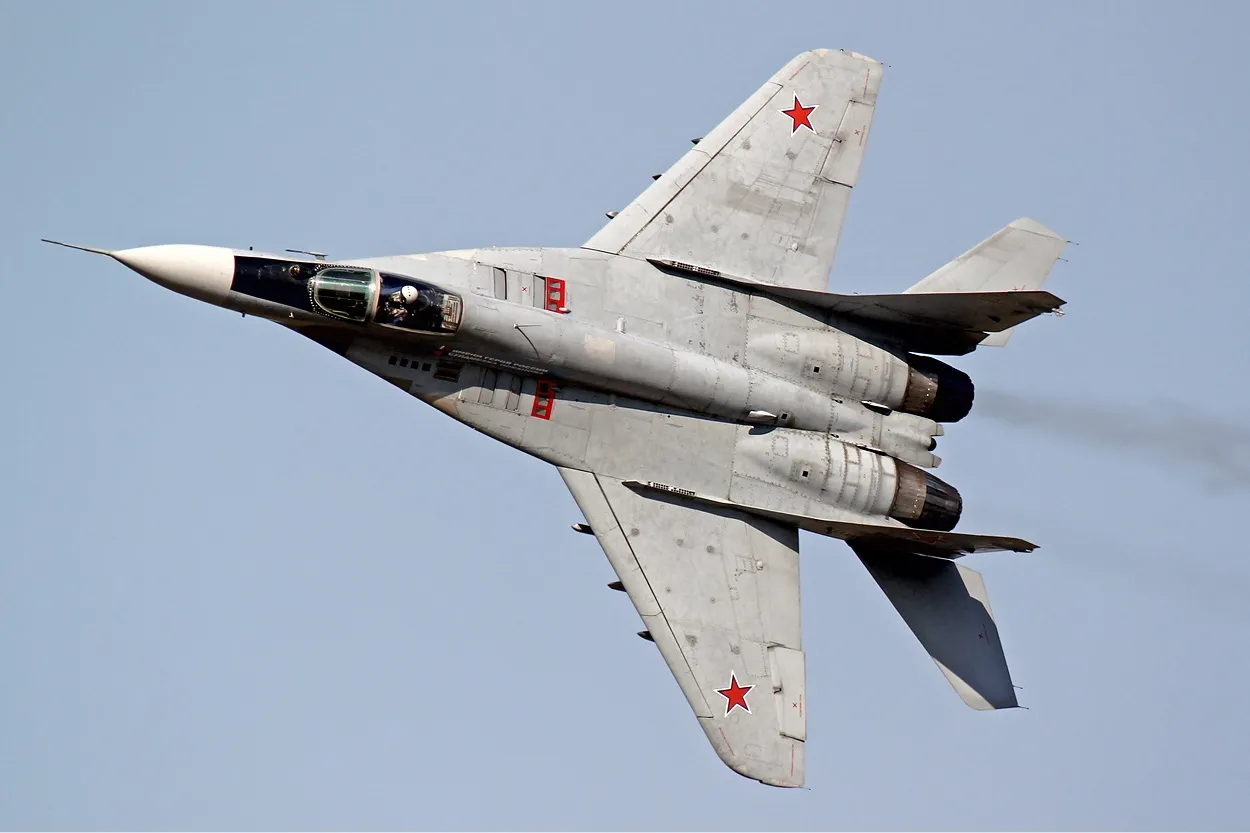
The Mikoyan MiG-29 is a twin-engine, highly manoeuvrable fighter built for air superiority and later adapted to strike ground targets as well. The Mikoyan design bureau developed it in the Soviet Union as the lightweight counterpart to the heavier Sukhoi Su-27, aimed at matching Western fighters such as the F-15 and F-16. Known to NATO by the reporting name “Fulcrum,” it has been built in more than 1,600 examples between 1981 and 2019 and remains in service1 with air forces on several continents.
Design and development
The MiG-29 traces back to a 1969 Soviet General Staff requirement for an “Advanced Frontline Fighter,” which by 1971 split into a heavy programme given to Sukhoi (becoming the Su-27) and a lightweight programme given to Mikoyan. Mikoyan began detailed work on the resulting design, internally “Product 9,” in 1974. The prototype made its first flight on 6 October 1977 at the Zhukovsky flight test centre1, and American reconnaissance satellites photographed the pre-production aircraft the following month, giving it the temporary Western designation “Ram-L” after the Ramenskoye airfield nearby.
The airframe pairs a mid-mounted, sharply swept wing with wide leading-edge root extensions, and carries its two vertical tail fins on separate engine booms. Unlike the Su-27, the MiG-29 was built without fly-by-wire controls, relying instead on conventional hydraulic controls with a three-axis autopilot, and its aluminium structure is stressed for manoeuvres up to 9 g. Early production aircraft used the Phazotron N019 “Sapfir-29” pulse-Doppler radar, which gave the type look-down/shoot-down capability; later variants moved to the N010 “Zhuk-M” radar with a planar array antenna. The aircraft also carries a GSh-30-1 30 mm cannon in the port wing root1.
Specifications
The MiG-29 is 17.32 m long with a wingspan of 11.36 m, and has a maximum take-off weight of 18,000 kg. It carries a single pilot, or two in the MiG-29UB trainer variant, and is powered by two Klimov RD-33 afterburning turbofan engines, each rated at 50 kN dry thrust and 81.3 kN with afterburner. Its ferry range with an external drop tank is 2,100 km; on internal fuel alone the range drops to 1,430 km, and its combat radius with two R-27 and four R-73 missiles at high altitude is 700–900 km. Internal fuel capacity grew from 4,300 litres on early aircraft to 4,540 litres on later versions1.
Variants
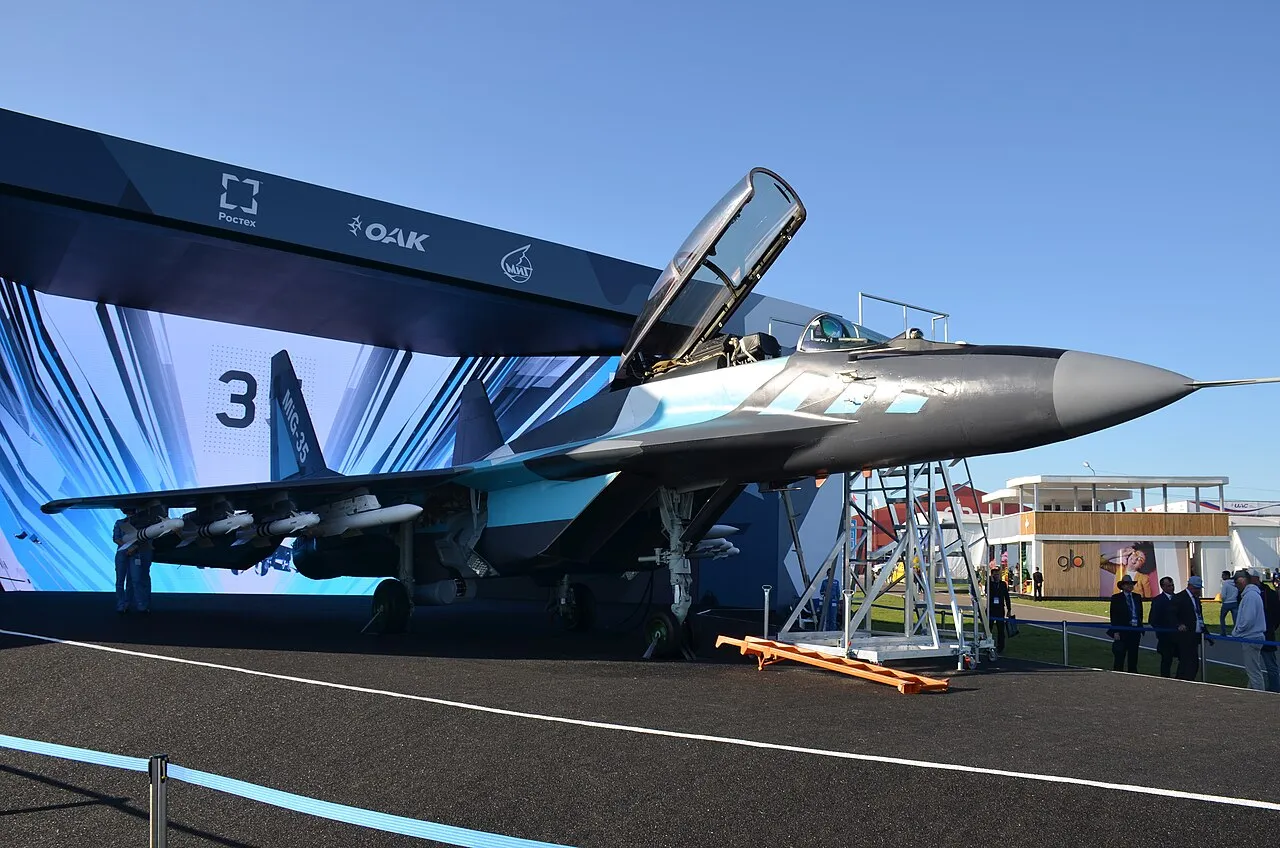
The baseline export models were the MiG-29 9-12A, built with full avionics for Warsaw Pact air forces, and the downgraded 9-12B for non-aligned customers. The MiG-29S added a dorsal spine housing extra fuel and jamming equipment, and could carry the longer-range R-27E missile, while the MiG-29UB is the two-seat trainer version. A naval variant, the MiG-29K, was developed for operation from aircraft carriers, and the MiG-29M brought the Zhuk-M radar and more modern avionics. The MiG-29SMT is a modernised configuration with an extended service life of 4,000 flight hours, and India flies its own upgrade, the MiG-29UPG, with new engines, radar and weapons. The newest member of the family, the MiG-35, uses improved engines and a mesh-screen air intake design1.
Operators and service
The type entered service with the Soviet Air Forces in August 1983 and today flies with the Russian Aerospace Forces, among others. India was the first customer outside the Warsaw Pact, inducting 40 single-seat and 4 twin-seat aircraft from 1987; its air force has since upgraded its fleet to the MiG-29UPG standard, while the Indian Navy flies 36 MiG-29Ks from its aircraft carriers. Indian MiG-29s escorted Mirage 2000 strike aircraft during the 1999 Kargil War and took part in the 2019 Balakot counter-strike. East Germany received 24 aircraft in 1988–1989, which passed to the unified German air force after 1990; German pilots who flew it alongside NATO types found it highly manoeuvrable at low speed but outmatched in beyond-visual-range engagements by the radars and missiles of the F-15 and F-161.
Yugoslavia took delivery of 14 MiG-29s and 2 trainers in 1987–1988, and six were shot down during NATO’s 1999 intervention in Kosovo; Serbia now operates 14 MiG-29s, donated by Russia and Belarus to replace losses. Ukraine inherited roughly 240 aircraft from the Soviet Union, of which about 70–80 remained operational by 2011; after the 2022 Russian invasion, Ukrainian technicians adapted Ukrainian MiG-29s to carry AGM-88 HARM anti-radiation missiles using improvised tablet-and-GPS targeting equipment. Algeria, Poland, Malaysia and North Korea are among the type’s other operators1.
Safety record
Corrosion-related cracking in the tail fins was found in both the Russian and Indian fleets, and Russia grounded 90 MiG-29s after a crash in October 2008; a second crash in December 2008 exposed wider maintenance problems, leading investigators to judge about 70% of the Russian fleet too old to fly safely. By March 2009, 91 Russian MiG-29s needed repairs and only about 100 were cleared to fly. India has lost around 25 MiG-29s to accidents between 1989 and 2025. Two Russian Air Force MiG-29s collided in mid-air during a display at the Royal International Air Tattoo in July 1993, and a MiG-29K crashed off the Syrian coast after fuel exhaustion in November 20161.
Similar aircraft
- Sukhoi Su-27: the heavier fighter developed alongside the MiG-29 from the same 1969 Soviet requirement, built for longer-range air superiority.
- General Dynamics F-16 Fighting Falcon: the lightweight Western fighter the MiG-29 was designed to counter, flown in large numbers by NATO and allied air forces1.
_fA8XS.webp)
_2dTk34.webp)
_ZfgbMz.webp)