Contents
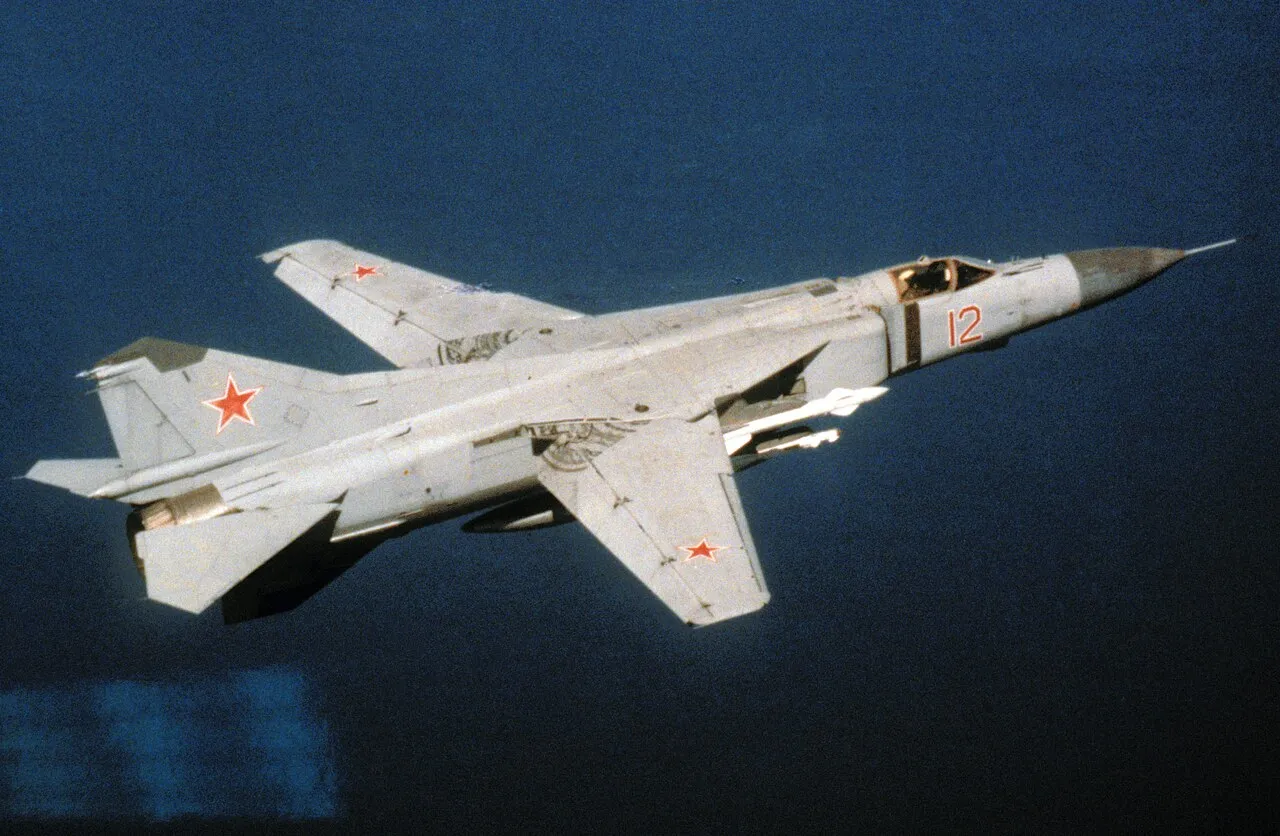
The Mikoyan-Gurevich MiG-23 is a single-engined, supersonic, variable-sweep wing fighter developed by the Mikoyan-Gurevich design bureau in the Soviet Union. Known to NATO by the reporting name “Flogger,” it was designed as a replacement for the MiG-21 with longer range, better avionics and a beyond-visual-range missile capability. More than 5,000 were built, making it the most-produced variable-sweep wing aircraft in history, and a dedicated ground-attack derivative, the Mikoyan MiG-27, extended the design’s service life further. A handful of air forces, including Syria’s, still fly the type1.
Design and development
Work on a MiG-21 successor began in the early 1960s, and Mikoyan pursued two competing approaches. The first, the MiG-23PD, added lift jets that first flew on 3 April 1967 but proved unsatisfactory because the jets became useless dead weight once airborne. The second, the 23-11 prototype, used variable-geometry wings that could be set to 16, 45 or 72 degrees and proved the superior layout. That prototype first flew on 10 June 19672 with test pilot Aleksandr Fedotov at the controls, and series production began after December 1967, with the first production MiG-23S flying on 21 May 19691.
Early production aircraft used the RP-22SM Sapfir-21 radar carried over from the MiG-21S/SM, a stopgap that the definitive MiG-23M replaced with the Sapfir-23D, the type’s first radar with a look-down/shoot-down capability. The aircraft’s layout drew on Western fighters such as the F-111 and F-4 Phantom, though Mikoyan kept it lighter than its American counterparts to preserve some dogfighting ability. Soviet pilots initially struggled with the new type: stability issues and limited manoeuvrability led to numerous flight restrictions1 before crews adapted to it.
Specifications
The MiG-23 is 16.7 metres long2, with a wingspan of 13.965 metres fully spread, narrowing to 7.779 metres fully swept. Maximum take-off weight reaches 17,800 kg, and a single Khatchaturov R-35-300 afterburning turbojet powers it to a top speed of Mach 2.35, about 2,500 km/h at altitude, and Mach 1.14 at sea level. Ferry range with three 800-litre drop tanks is about 2,360 km, falling to a combat radius of 1,450 km with standard armament and no drop tanks. A single pilot flies the combat versions; the MiG-23UB trainer seats two1.
Variants
The initial production model, the MiG-23S, carried the S-21 fire control system and four R-3/K-13 air-to-air missiles plus a GSh-23L cannon. The MiG-23M became the definitive first-generation variant, fitted with the Sapfir-23D radar and able to carry the longer-range R-23 missile alongside the short-range R-60; from aircraft number 3201 a double-rail launcher let it carry six R-60s. The MiG-23ML, a second-generation version, added a new weapons system and shed weight to improve performance, while the ultimate fighter version, the MiG-23MLD, strengthened the wing pivot to allow a fourth sweep position of 33 degrees for close combat, though pilots found the aircraft much harder to handle in that setting. The two-seat MiG-23UB trainer also flew operational strike and reconnaissance missions1.
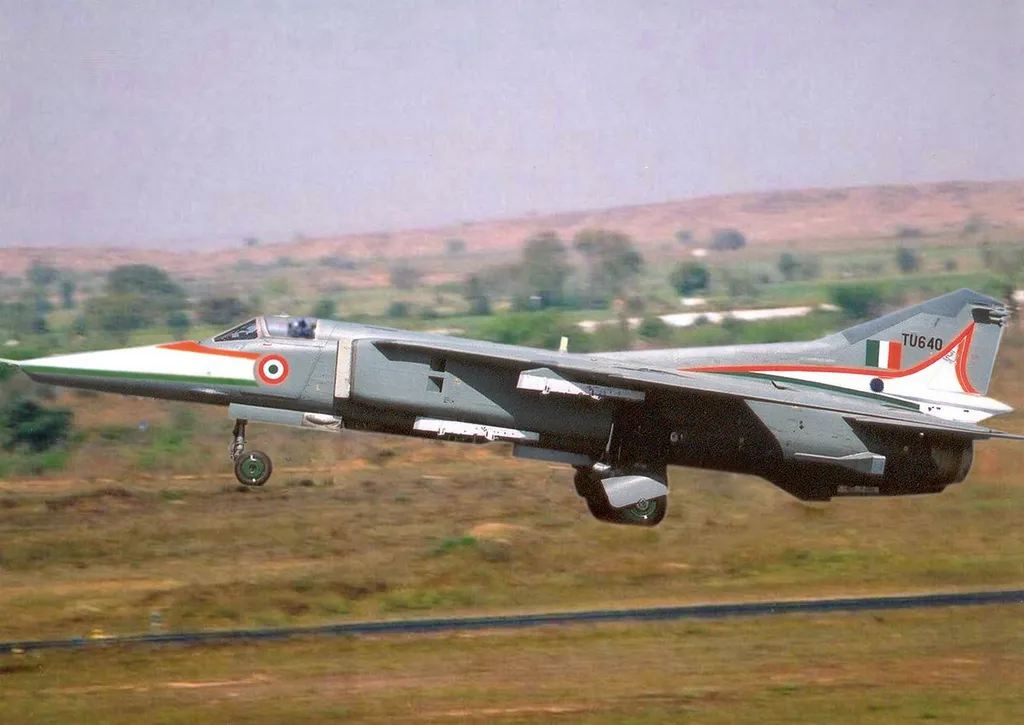
A ground-attack line developed in parallel: the MiG-23B, upgraded through the MiG-23BK and MiG-23BM, in turn formed the basis for the dedicated Mikoyan MiG-27, which swapped the radar for an optical panel carrying a laser designator and TV camera. The widely exported MiG-23BN was a separate upgrade of the MiG-23B built from 1973 to 19851.
Operators and service
The Soviet Air Forces formally commissioned the MiG-23 on 4 January 1974, and it flew combat missions over Afghanistan from April 1982, where its longer range let it escort strikes beyond the reach of the MiG-21. Soviet MiG-23MLDs there shot down two Iranian AH-1J Cobra helicopters with R-23 missiles in 1988. The Soviet Union’s last air-defence variant, the MiG-23P, was retired on 1 May 19981.
The type spread widely among Soviet allies. Syria received its first MiG-23s in April 1974, and a Syrian pilot shot down two Israeli F-4Es on 19 April 1974; Syria lost 11 to 13 MiG-23 fighters in air combat with Israel between 1982 and 1985 but continued flying the type into the Syrian civil war after 2011. Iraq used its MiG-23s on the first day of the Iran-Iraq War, 22 September 1980, in strikes on Iranian airbases, and by the 1991 Gulf War Iraqi losses totalled 43 MiG-23s destroyed from all causes. Libyan MiG-23s were shot down by US Navy F-14s in the 1989 Gulf of Sidra incident, and the French Air Force destroyed five more on the ground at Misrata on 26 March 2011 during the Libyan civil war. Warsaw Pact air forces such as East Germany, Poland, Hungary and Czechoslovakia also operated the type until retiring it between the 1990s and 2000s, alongside users including India, North Korea, Cuba, Sudan and Ethiopia1.
Safety record
American pilots who flew captured examples during the classified Constant Peg evaluation programme found the MiG-23 dangerous to fly, citing narrow landing gear prone to slipping, low ground clearance inviting foreign-object damage and structural vulnerability to overstressing; at high angle of attack it became unstable and liable to depart controlled flight, earning it the nickname “Looping Hog” among those test pilots. Its KM-1 ejection seat was not a zero-zero design and needed a minimum speed of 90 knots to work safely. Accident rates in service were high: by the 1980s the Soviet Air Forces averaged 12.5 losses per 100,000 flying hours on the type, a figure far worse in allied air forces, with Hungary recording 24.3 and East Germany 20.4 per 100,000 hours1.
Similar aircraft
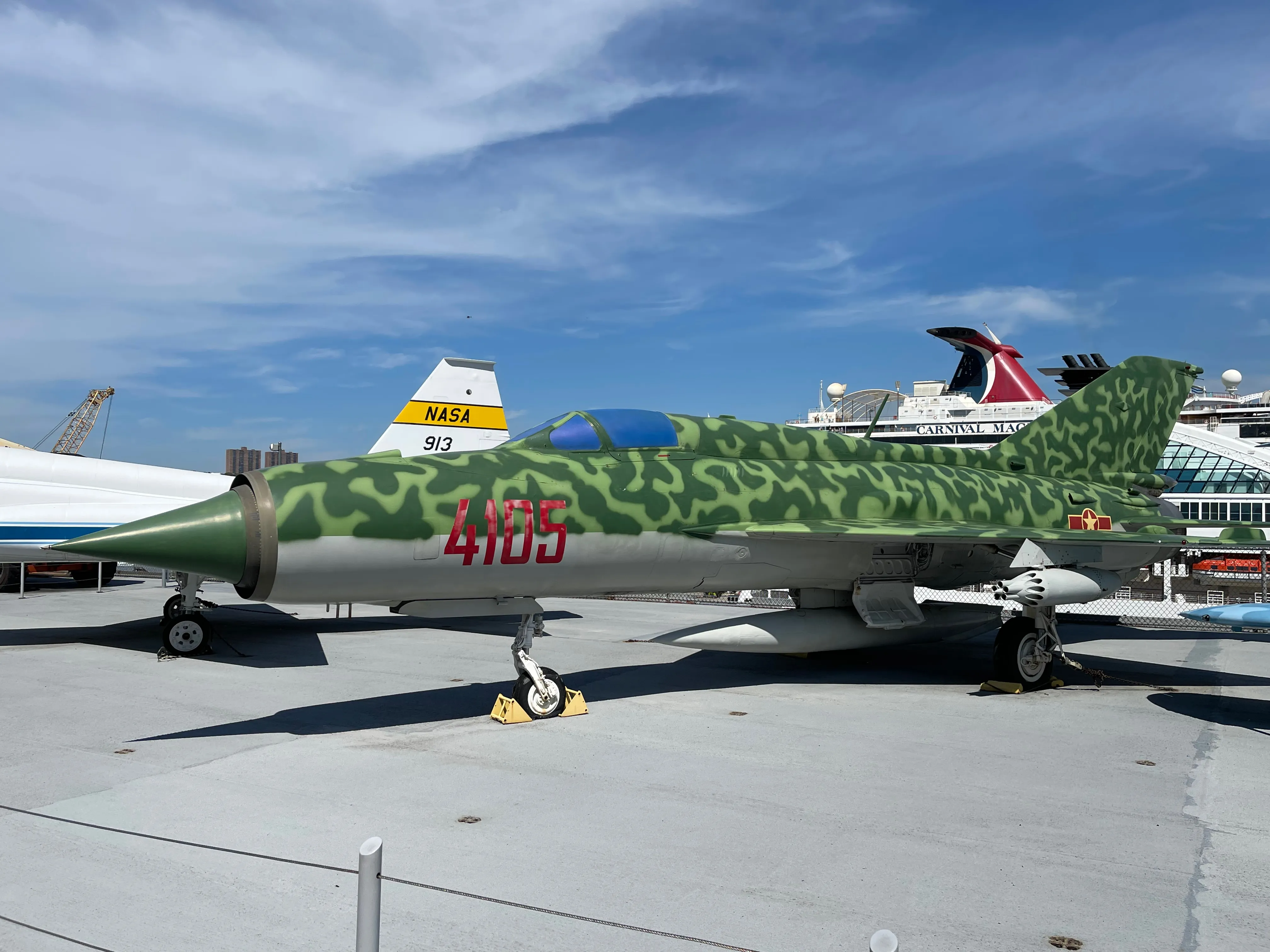
- Mikoyan-Gurevich MiG-21: the Soviet fighter the MiG-23 was designed to replace, and the aircraft it inherited much of its early radar equipment from.
- McDonnell Douglas F-4 Phantom II: the American fighter the MiG-23 met in combat over the Middle East, and one of the Western types whose layout influenced its design.
- General Dynamics F-111 Aardvark: the other Western variable-sweep aircraft cited alongside the F-4 as an influence on the MiG-23’s layout.
_fA8XS.webp)
_2dTk34.webp)
_ZfgbMz.webp)