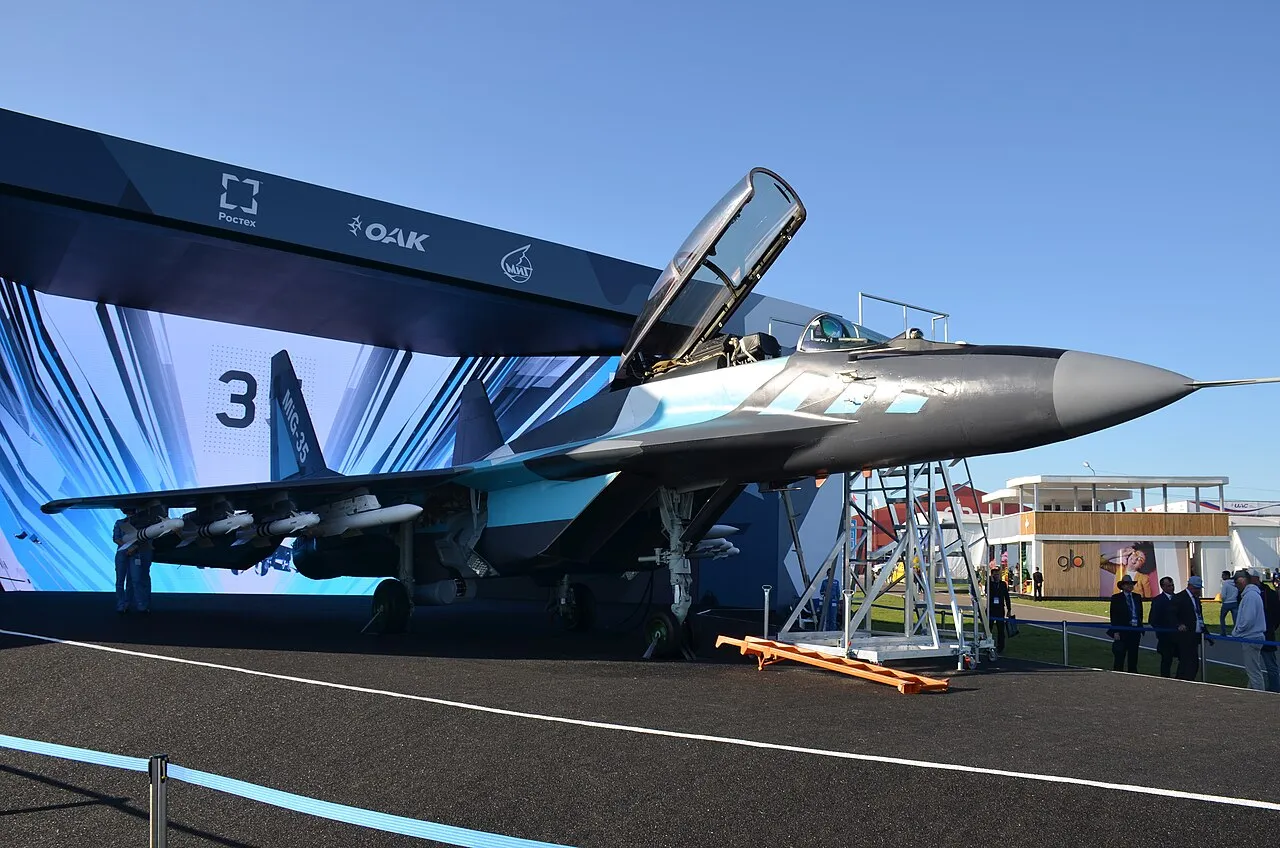
The Mikoyan MiG-35 is a multirole fighter built by Mikoyan, a division of the United Aircraft Corporation, as a deep modernisation of the Soviet-era MiG-29 “Fulcrum”. It is intended for both air superiority and ground attack, and carries an upgraded radar, avionics and engines over its predecessor. The type entered service with the Russian Aerospace Forces1 after a long and troubled development, during which Mikoyan repeatedly failed to find the export customers it had designed the aircraft to attract.
Design and development
Russia first showed a “MiG-35” at the 2007 Aero India air show, as a rebranded version of the MiG-29M offered for export. That aircraft competed in India’s MRCA fighter competition against the Eurofighter Typhoon, F/A-18 Super Hornet, Rafale, Gripen, Su-35 and F-16, but problems with its radar and its Klimov RD-33MK engines saw it dropped from the contest in April 20111.
Mikoyan reworked the design after that defeat. It showed an entirely new MiG-35 prototype to the Russian government on 26 January 2017, with a new fly-by-wire flight control system, an improved cockpit, upgraded avionics and integrated precision-guided targeting — effectively the aircraft that later entered Russian service, since the type’s first flight is dated to December 2016. To hold down costs, the production standard dropped two features planned for the aircraft: it flies without the thrust vectoring once envisaged, and with a mechanically scanned Zhuk-M radar rather than the active electronically scanned array (AESA) radar originally planned; Mikoyan offers both features back as options on export orders. The aircraft carries an OLS-35 optical locator system for targeting without relying on radar, and can carry up to 6.5 tonnes of weapons on nine hardpoints1.
Russia’s own order shrank as the programme went on: the air force planned 37 aircraft in 2013, then cut the order to 24, with the first six contracted in August 2018. Only two of those were delivered by 17 June 2019, and about six serial aircraft plus prototypes had been built between 2016 and 20241 — a fraction of the numbers Mikoyan built of the original MiG-29.
Specifications
The MiG-35 is 17.3 metres long with a wingspan of 12 metres, close to the dimensions of the MiG-29 it replaces. Its maximum take-off weight is 24,500 kg. It is powered by two Klimov RD-33MK afterburning turbofans, each rated at 52 kN dry and 88.2 kN with afterburner, giving it a cruise speed of about 804.7 km/h1.
Range figures depend heavily on fuel carried: Wikipedia gives a combat radius of about 1,000 km, extending to 3,000 km as a ferry flight with three external tanks, or 6,000 km with one in-flight refuelling and three external tanks. The aircraft flies with one pilot in the single-seat MiG-35S or two in the tandem-seat MiG-35UB trainer version1.
Variants
Russian serial production covers two versions: the single-seat MiG-35S, which carries an extra fuel tank, and the two-seat MiG-35UB. Beyond those, Mikoyan has kept a naval version under development, with landing systems adapted for carrier operations, and offers export customers the AESA radar and thrust vectoring left out of the Russian production standard1. None of those export or naval versions has yet been built in series; the MiG-35S and MiG-35UB delivered to Russia remain the only variants actually in service.
Operators and service
The Russian Aerospace Forces is the only confirmed operator, having received its first two serial MiG-35s on 17 June 2019. The type stayed out of combat for years after that; Wikipedia records that it first saw service in the Russo-Ukrainian war in May 2025, when the Russian defence ministry confirmed MiG-35s had been deployed to defend Moscow against Ukrainian drone strikes1.
Export sales have not followed the service entry. Mikoyan’s attempts have repeatedly fallen through: a planned 24-aircraft deal with Egypt in 2014–2015 was cancelled, with Egypt instead buying 46 MiG-29M/M2 aircraft; after its 2011 MRCA defeat, India considered the MiG-35 again for a follow-on MMRCA 2.0 competition without a sale resulting; a tender for Bangladesh collapsed in 2017 for lack of funding; Russia offered Malaysia two squadrons between 2019 and 2021 without reaching an agreement; and an offer to Argentina in 2021, bundled with anti-ship missiles, stayed under consideration only. Wikipedia’s assessment is blunt: Mikoyan “secured neither foreign buyers nor substantial domestic orders1” with the type, a result the article ties to the wider decline of the Mikoyan bureau as an independent fighter designer.
Similar aircraft
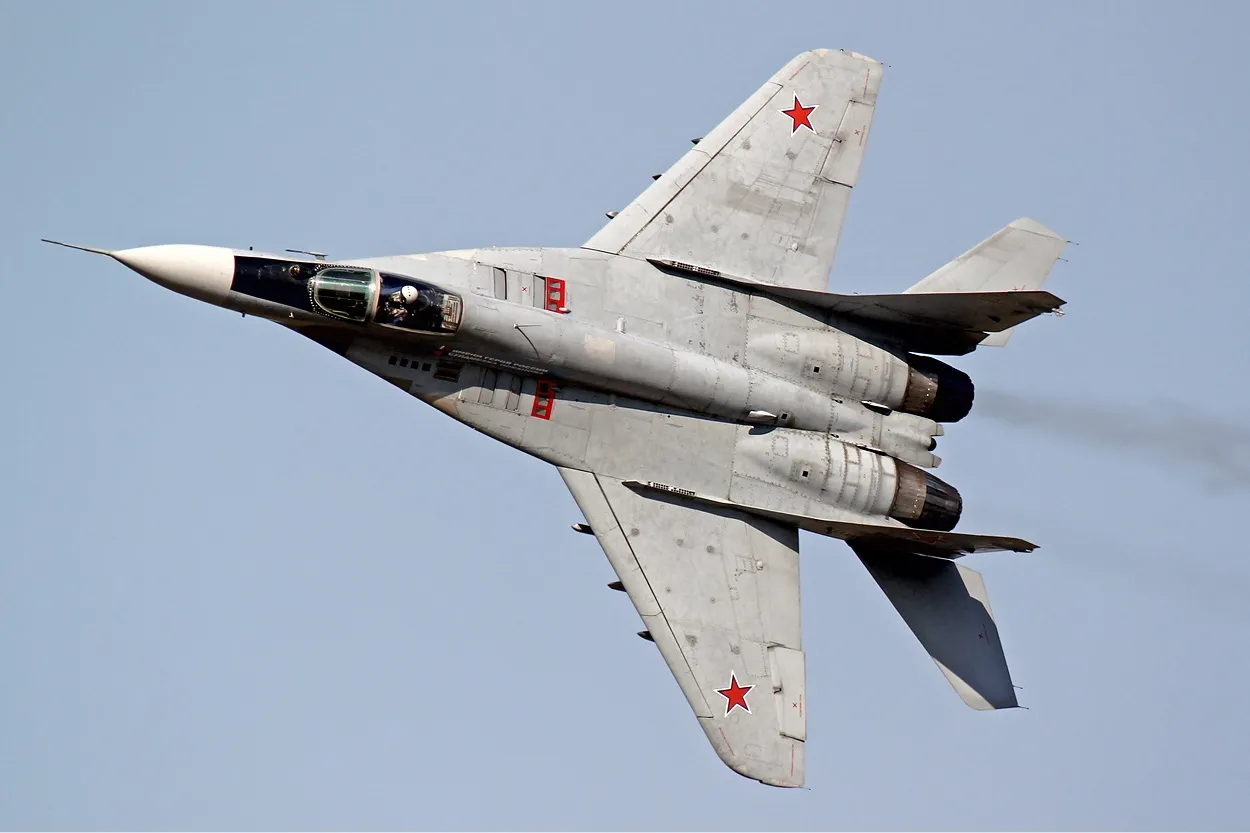
- Mikoyan MiG-29: the Soviet-era fighter the MiG-35 modernises and replaces, sharing its basic airframe layout.
- Sukhoi Su-35: a heavier, longer-range Russian air-superiority fighter from the rival Sukhoi bureau.
- Dassault Rafale: another of the six fighters that competed in India’s MRCA contest alongside the MiG-35, and remains a rival in export markets the MiG-35 has failed to break into.
_fA8XS.webp)
_2dTk34.webp)
_ZfgbMz.webp)