_2dTk34.webp)
Contents
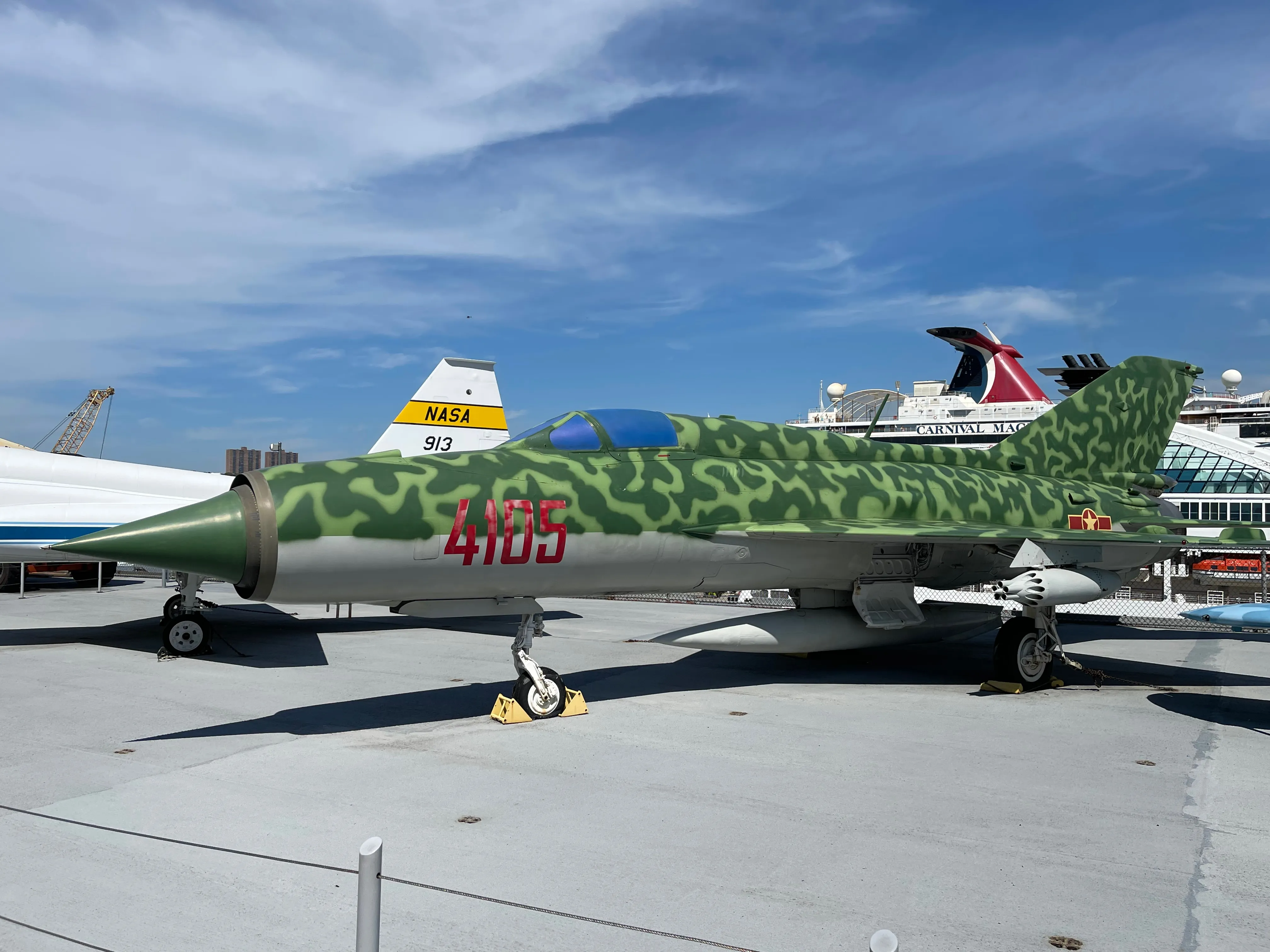
The Mikoyan-Gurevich MiG-17 is a single-engine, swept-wing jet fighter developed from the earlier MiG-15. Mikoyan-Gurevich built it for the Soviet Union, and although it arrived too late for the Korean War, it became famous a decade later for its dogfighting performance against faster, more modern American jets over North Vietnam1. NATO gave it the reporting name “Fresco.”
Design and development
The MiG-17 began as an attempt to fix the MiG-15’s shortcomings at high speed. The prototype, designated I-330, made its first flight on 14 January 1950, with a more sharply swept and thinner wing than the MiG-15 to delay the onset of compressibility problems near the speed of sound. Early production aircraft kept the MiG-15’s engine, but the definitive MiG-17F variant introduced the Klimov VK-1F, an afterburning version of the earlier VK-1 turbojet1, giving the fighter better acceleration and climb.
The type shared much of its fuselage and systems with the MiG-15, which let Soviet industry bring it into service quickly, but pilots and planners initially saw it as an incremental update rather than a major advance. That changed once the MiG-17 met modern Western jets in combat: its tight turning radius and small size made it a dangerous opponent for the faster but less manoeuvrable aircraft the United States flew over Vietnam1.
Specifications
The MiG-17F variant is 11.264 m long with a wingspan of 9.628 m, and its maximum take-off weight reaches 6,069 kg. With two 400-litre drop tanks it has a ferry range of about 2,020 km at 12,000 m. Power comes from a single Klimov VK-1F afterburning centrifugal-flow turbojet in the MiG-17F, an afterburning evolution of the engine that powered the MiG-15. The fighter carries a single pilot1.
Variants
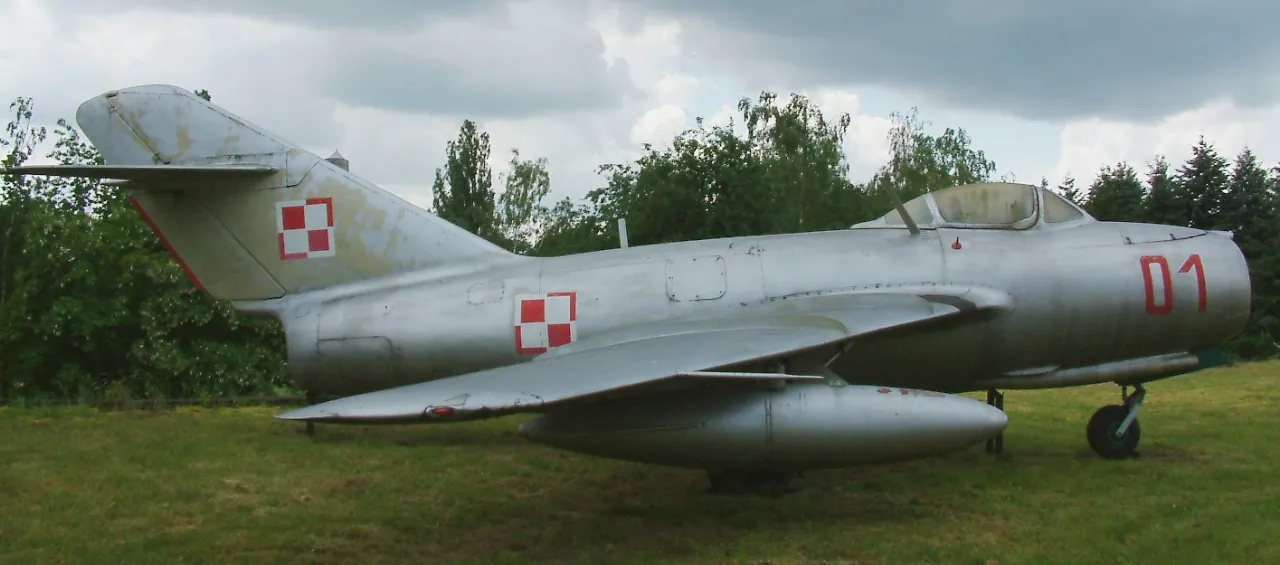
Beyond the baseline MiG-17, the Soviet Union built the MiG-17P all-weather interceptor with search radar, and the MiG-17F and MiG-17PF, which added the afterburning VK-1F engine to the day fighter and the radar-equipped interceptor respectively. The design was also built under licence in Poland and Czechoslovakia, and manufactured in China as the Shenyang J-51, widening its production base well beyond the Soviet Union.
Operators and service
Soviet factories alone built 7,999 MiG-17s by 1958: 5,467 baseline MiG-17s, 1,685 MiG-17Fs, 225 MiG-17Ps and 668 MiG-17PFs. Counting licensed and derivative production in Poland, Czechoslovakia and China, total output reached about 10,649 aircraft. It flew with the Soviet Union, China, North Vietnam and a long list of other air forces allied with Moscow or Beijing through the Cold War. Today it is in limited service only with a small number operated by North Korea1, having been retired from most other air forces.
Safety record
The type’s combat reach showed early: in 1958, Soviet-flown MiG-17s shot down a US Air Force C-130 reconnaissance aircraft. Its sharpest test came later, over North Vietnam, where its tight turning performance let it repeatedly outmanoeuvre larger, faster American fighters such as the F-4 Phantom II in close dogfights1, despite the MiG-17’s older design and lower top speed.
Similar aircraft
- Mikoyan-Gurevich MiG-15: the earlier swept-wing Mikoyan-Gurevich fighter the MiG-17 was developed from.
- Mikoyan-Gurevich MiG-21: the delta-wing fighter that succeeded the MiG-17 in Soviet service and also flew over Vietnam.
- McDonnell Douglas F-4 Phantom II: the American fighter-bomber the MiG-17 frequently fought in Vietnam War dogfights.
_fA8XS.webp)
_ZfgbMz.webp)