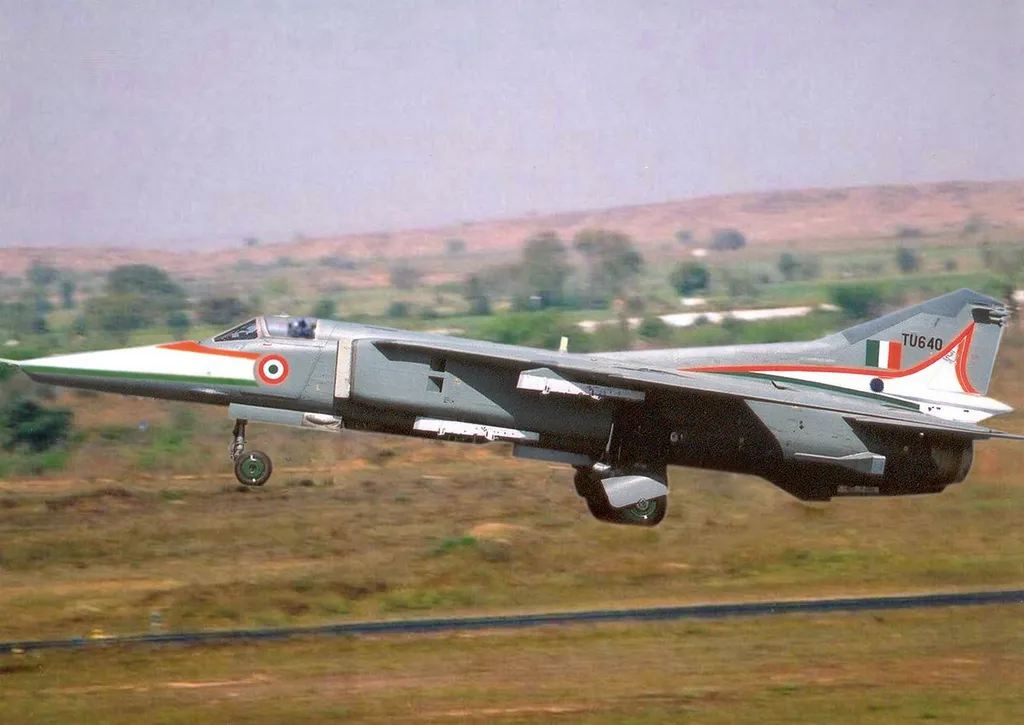
The Mikoyan MiG-27 is a single-engine, variable-sweep wing ground-attack aircraft developed in the Soviet Union from the MiG-23 fighter. Where the MiG-23 was built to intercept and dogfight, the MiG-27 traded its parent’s variable-geometry air intakes and radar for a simplified, fixed intake and a laser rangefinder and ground-attack avionics suited to close air support. Mikoyan-Gurevich built the type in the Soviet Union, and Hindustan Aeronautics later licence-produced it in India as the Bahadur. It is now retired everywhere, with the last examples withdrawn by late 20231.
Design and development
The MiG-27 grew directly out of the MiG-23’s ground-attack variants. Mikoyan’s design bureau reworked the fighter’s nose, replacing its radar with a laser rangefinder and simplifying the variable-geometry intakes into fixed ones, since the attack version had no need for the high-speed intercept performance those features served. The resulting aircraft first flew on 20 August 19702, and it entered production as a dedicated strike platform built to carry a heavier weapons load over the battlefield and survive ground fire better than a pure fighter1.
Soviet production ran from the early 1970s, and the type stayed in production until 19952, with India as the main customer for continued manufacture after Soviet lines closed. Hindustan Aeronautics built the MiG-27 under licence in India as the Bahadur1, extending the design’s working life well past most of its Soviet-built siblings.
Specifications
The MiG-27 is 17.08 metres long, with a wingspan of 13.97 metres fully spread and 7.78 metres fully swept. Maximum take-off weight reaches 20,670 kg, and one Tumansky R-29-B-300 afterburning turbojet powers it. Top speed is 1,350 km/h, Mach 1.09, at sea level, rising to 1,885 km/h, Mach 1.7, at altitude. Combat range on a strike mission is about 780 km, extending to a ferry range of 2,500 km with drop tanks. A single pilot flies the aircraft1.
Variants
Soviet production covered several standard marks, and Hindustan Aeronautics’ India-built version, the MiG-27M, was marketed under the name Bahadur (“valiant”)1. In total, 1,075 MiG-27s were built between 1972 and 19952 across the Soviet and Indian production runs.
Operators and service
The Soviet Air Force flew the MiG-27 as a frontline strike aircraft during the Cold War, and the type saw export to Warsaw Pact and allied air forces. India, where the Indian Air Force operated the type, including the licence-built Bahadur, as a ground-attack platform, kept it flying for decades after most Soviet-built examples retired, finally withdrawing its last MiG-27ML squadron on 27 December 2019. The type’s longest service was actually in Kazakhstan, whose air force kept 12 MiG-27s flying until October 2023, when it retired and auctioned them off1, closing out the type’s operational life worldwide.
Similar aircraft
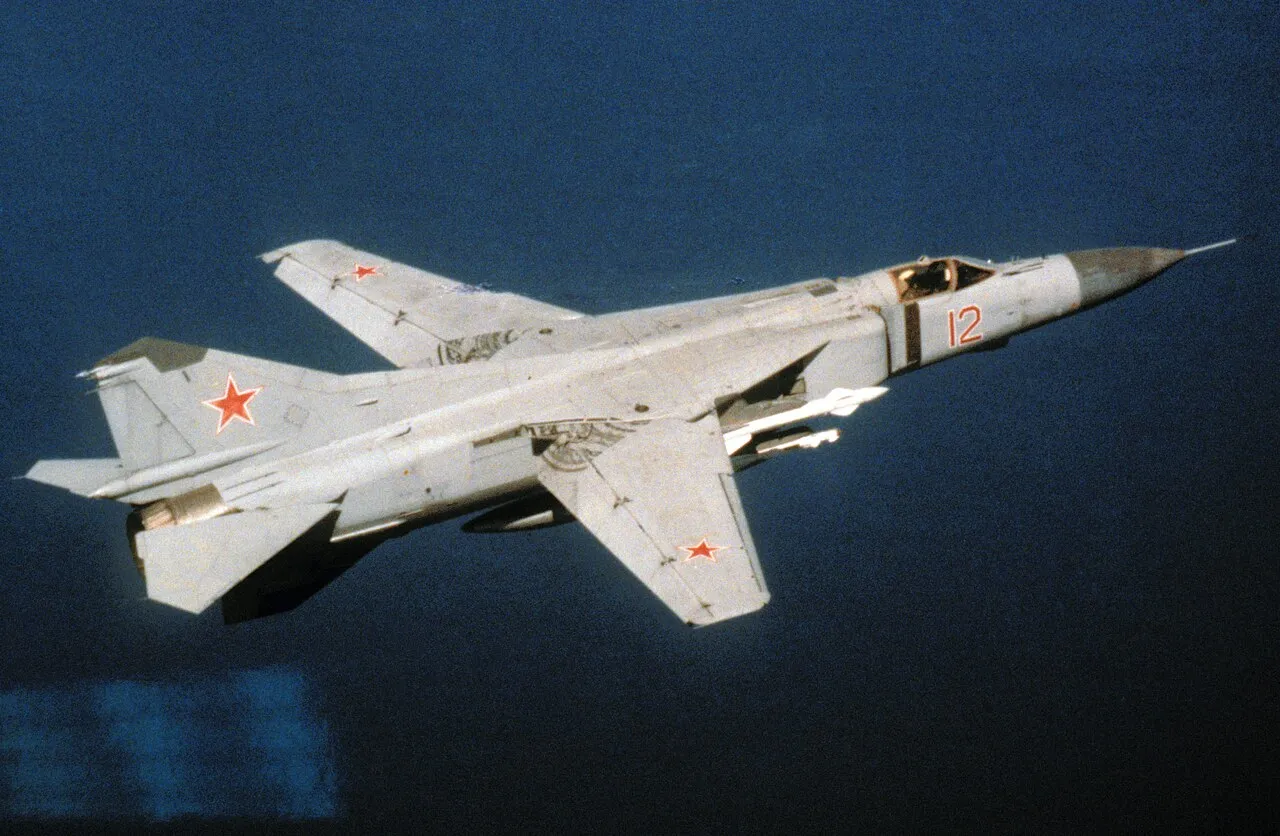
- Mikoyan-Gurevich MiG-23: the variable-sweep wing fighter the MiG-27 was derived from, sharing its airframe but built for air combat rather than ground attack.
- Sukhoi Su-25: a contemporary Soviet ground-attack aircraft built for the same close air support role, though a single-engine subsonic design rather than a converted variable-sweep fighter.
_fA8XS.webp)
_2dTk34.webp)
_ZfgbMz.webp)