Contents
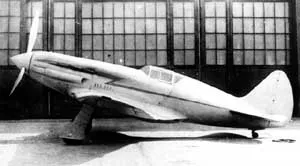
The Mikoyan-Gurevich MiG-1 was a Soviet fighter of the Second World War, designed to meet a 1939 requirement for a high-altitude fighter. Because of mass-production concerns and scarce metals, its outer wing panels, rear fuselage and tail were made of wood2. Serious faults limited production to 100 aircraft before the radically modified MiG-3 took over3. The type reached Soviet Air Forces (VVS) fighter regiments in 1941, but most were destroyed in the opening days of the German invasion1 of June 1941.
Design and development
The VVS asked for a high-altitude fighter with an inline engine in January 1939, and the design, designated I-200, was started in Nikolai Polikarpov’s bureau in June 1939. When Polikarpov fell out of favour with Stalin, the authorities split up his team and created an Experimental Construction Section (OKO) headed by Artem Mikoyan and Mikhail Gurevich, who took over the I-2001.
The new section shaped the I-200 as the smallest possible airframe around the Mikulin AM-37 engine. Under government pressure it went from its first production drawings to the first flight of the prototype in 100 days. The AM-37 never arrived in time, so the team had to use the AM-35, which developed 180 hp less2. Shortages of light alloys also shaped the structure: the front fuselage was a welded steel-tube truss covered in duralumin, the rear fuselage wood, and the wing mostly wooden around an all-metal centre section1.
The test pilot Ekatov first flew the prototype on 5 April 1940, and on 24 May it reached 648 km/h at 6,900 m, a figure the same source calls exceptional beyond the Soviet Union. The type was ordered into production on 31 May 19401. At a meeting on 13 September 1940 to discuss the test results, chief test pilot Suprun said the I-200 was the only prototype to pass the state tests at the first attempt4.
The trials also found serious defects, among them poor visibility when taxiing, heavy controls, poor longitudinal stability, a very hot cockpit and a tendency to flick from a simple stall into a spin. Only a few fixes reached the production line, because the VVS was anxious to get modern fighters into service. They included self-sealing fuel tanks, two underwing racks for 100 kg bombs and, from the ninth aircraft, a rear-sliding canopy. On 9 December 1940 the first 100 I-200s were designated MiG-11, after the initials of Mikoyan and Gurevich.
A fourth prototype gathered the next round of changes and first flew on 29 October 1940; its improvements entered production from the 101st I-2001. Those aircraft became the MiG-3, ordered into production in December 19402.
Specifications
The MiG-1 was a monoplane whose main gear retracted inward and whose tail wheel retracted rearward2. Its Mikulin AM-35A engine gave 1,350 hp and drove a controllable-pitch propeller 3 m in diameter1. The airframe was 8.155 m long with a wingspan of 10.2 m3, and the maximum take-off weight was 3,319 kg4.
At a loaded weight of 3,099 kg the wing loading was 177.7 kg/m². An archived Soviet aircraft reference describes the faults the type went into production with as a lack of manoeuvrability from small, overloaded wings, limited range, and weak protection and armament3, and it calls all of them the price of the aircraft’s small size.
At altitude the MiG-1 was quick: state tests gave a maximum of 628 km/h, recalculated later to 636 km/h at 7,600 m, and a service ceiling of 12,000 m. Lower down it was slower: a prototype reached 579 km/h at 2,220 m and 605 km/h at 3,630 m, and the state tests gave 486 km/h at sea level. Its range at 7,000 m was 580 km4. Production aircraft carried two 7.62 mm ShKAS machine guns and one 12.7 mm UBS machine gun, all in the nose2.
Variants
- I-200: the MiG-1 prototype, three built, known inside the design bureau as Samolet Kh and Izdeliye-611.
- I-200 with AM-37: the second prototype first flew with a prototype AM-37 engine on 6 January 1941; after severe vibration problems it failed in flight on 7 May1 and was destroyed in the crash.
- IP-201: the third prototype, generally used for armament trials, with two 23 mm MP-3 cannon in fairings under the wings4. It made its only flight on 1 December 1940, which ended in a forced landing before the guns could be fired1.
- MiG-1: the production fighter, limited to 100 aircraft3.
Operators and service
The Soviet Air Forces and the Soviet Navy flew the MiG-1. The VVS gave the 41st Fighter Regiment at Kacha in Crimea the operational trials, and by 22 February 1941, 89 had gone to regular fighter units1, notably regiments at Kaunas in Lithuania and Białystok in Poland. Output in spring 1941 was marred by constant modifications and numerous accidents, so the fighters reached units only in small numbers, and pilots were reportedly very displeased to give up their I-15s, I-153s and I-16s2.
On 1 June 1941 the VVS had 77 on hand, of which only 55 were operational, and eight more were with the Soviet Navy. Just four pilots had been trained to handle either the MiG-1 or the MiG-3. Little is known of the type in combat, as most were likely destroyed in the opening days of Operation Barbarossa; like hundreds of other Soviet aircraft on the morning of the German attack, most MiGs were destroyed on the ground2. One survived in the VVS inventory until it was recorded as withdrawn in 19441.
Safety record
Handling was the type’s weak point. The prototypes were dangerously unstable at high angles of attack, with a tendency to stall without warning and enter spins that were almost impossible to recover from. The archived Soviet reference records poor spin performance, due to a centre of gravity set too far aft3. Visibility from the aft-located cockpit was terrible, making the stall characteristics worse on takeoff and landing2.
Similar aircraft
- Mikoyan-Gurevich MiG-3: the direct successor, with more wing dihedral, the engine moved forward, more fuel, a new propeller, armour plate and a radio2.
- Yakovlev Yak-1: a rival in the same contest as the I-26; unlike the I-2001, it did not complete the state trials at its first attempt.
- Lavochkin LaGG-3: the third contender, the I-3011, which likewise did not complete the state trials at its first attempt.