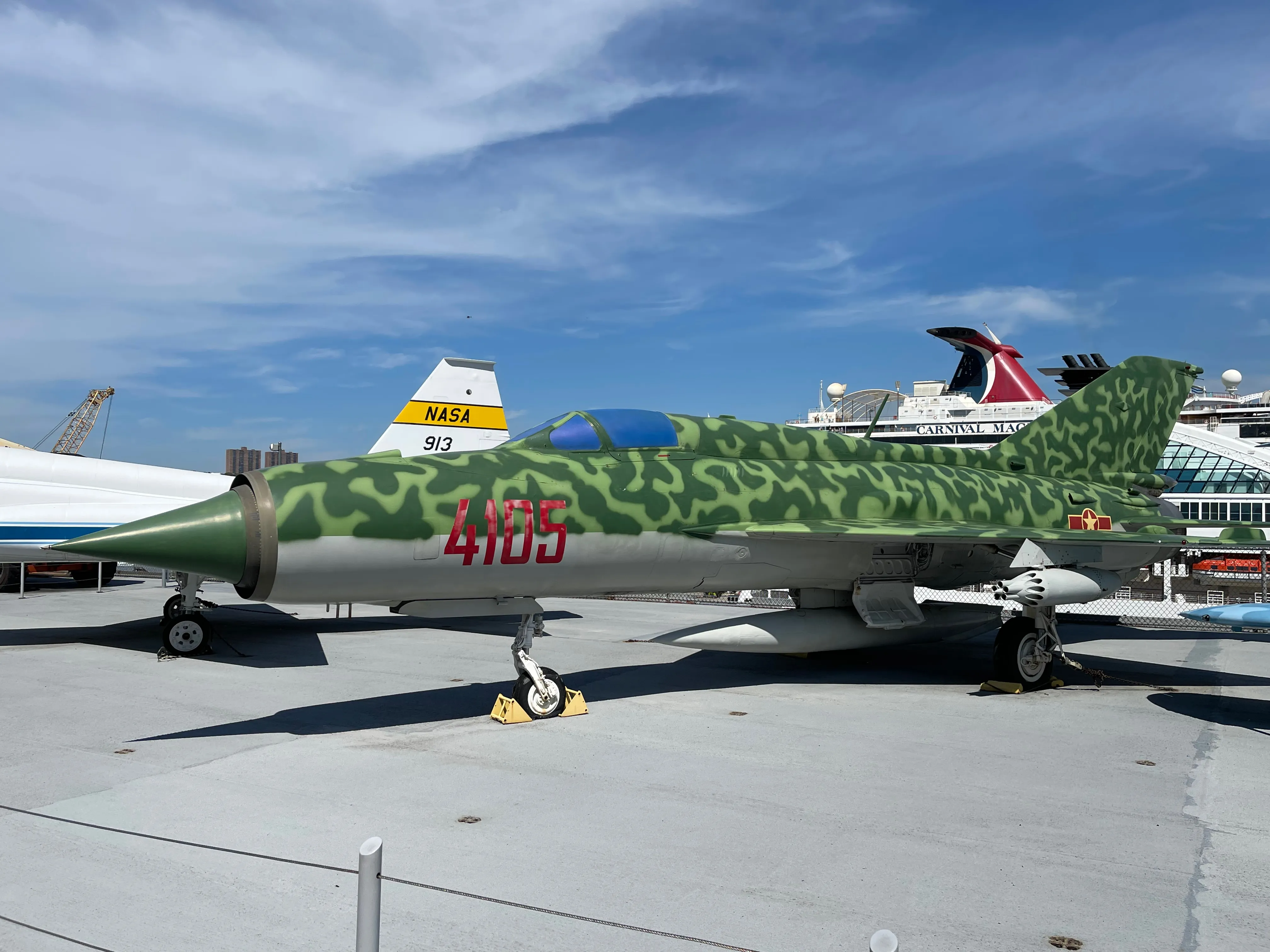
_cropped_ZK7zqp.webp)
The Mikoyan-Gurevich MiG-3 was a single-seat fighter built by the Soviet design bureau Mikoyan-Gurevich, developed as an improved version of its predecessor, the MiG-1. It made its first flight on 29 October 19401 and was conceived as a high-altitude interceptor for the Soviet Air Forces. It saw heavy service in the early, chaotic months of the German invasion of the Soviet Union before being withdrawn from front-line combat units.
Design and development
The MiG-3 grew directly out of the MiG-1, which flight testing had shown to carry numerous defects; designers Artem Mikoyan and Mikhail Gurevich reworked the airframe to fix them, and the revised aircraft completed its first flight on 29 October 1940. Production began on 20 December 1940, replacing the MiG-1 on the assembly lines1 at Factory No. 1 in Moscow, with secondary lines at Kiev and Gor’kiy.
The aircraft was built around one role: intercepting bombers at altitude. It carried a single Mikulin AM-35A V-12 liquid-cooled piston engine (see the facts box), tuned for performance high above the ground rather than at low level. That specialisation defined both its strengths and its problems: it was faster than contemporary German and British fighters at nearly 8,000 metres, but at sea level it was slower than the Messerschmitt Bf 109F-2, losing the altitude advantage that defined it. Pilots also found it unforgiving. Soviet pilot Alexander E. Shvarev later recalled that at lower altitudes it flew like “a cow”, and the type was prone to dangerous stalls and spins that particularly threatened inexperienced pilots at high altitude1.
Specifications
The MiG-3 was a single-seat fighter of modest size and limited range, built for speed and altitude rather than endurance (dimensions, weight and combat range in the facts box). Armament in the standard configuration was one 12.7mm UBS machine gun and two 7.62mm ShKAS machine guns mounted in the cowling, with later aircraft fitted with underwing pods carrying extra UBS guns or 20mm ShVAK cannons. Its altitude performance was unusual for the time: it reached 640 km/h (400 mph) at 7,800 m, well above what other fighters of the period could manage that high, but dropped to only 505 km/h (314 mph) at sea level1.
Variants
Soviet engineers tried several times to fix the MiG-3’s low-altitude weakness by changing its engine. The MiG-7, fitted with a Mikulin AM-37 engine, suffered from poor longitudinal stability and was cancelled as a single prototype after the German invasion. A version with an AM-38 engine was tested in July 1941, ran 14 km/h faster at sea level but overheated badly, and its sole prototype was shot down on 5 October 1941. A more radical redesign, the I-210 (also called the MiG-3-82), replaced the liquid-cooled engine with a Shvetsov ASh-82 radial and later evolved into the I-2111; the planned I-230 and I-231 successors never reached production. None of these replaced the MiG-3 in service.
Operators and service
Production ran from 1940 to 1941, with 3,422 aircraft built in total. Output peaked in the summer of 1941, with 496 delivered in July, 562 in August and 450 in September, before the German advance forced Factory No. 1 to evacuate to Kuybyshev that October. Soviet priorities then shifted to the Il-2 ground-attack aircraft, and only thirty more MiG-3s were assembled from spare parts in 19421.
By the time Germany invaded on 22 June 1941, about 981 MiG-3s were in service with the Soviet Air Forces, Air Defense Forces and Naval Aviation, though pilot training lagged badly behind deliveries, with only 494 trained pilots for 1,029 aircraft by 1 June 1941. The type’s high-altitude design suited it poorly to the low-level combat that dominated the Eastern Front, where it was outmatched by the Bf 109 and even by the Soviet Yak-1, and it proved totally unsuited to the ground-attack missions it was sometimes assigned. Losses were severe: 1,432 MiG-3s were shot down, the highest loss rate of any Soviet fighter type in the war. Even so, in the hands of a skilled pilot it could still perform: Aleksandr Pokryshkin, who finished the war as the Soviet Union’s third-ranking ace with 53 official victories, scored many of his early kills flying the MiG-31.
By autumn 1941 the Soviet Air Forces transferred most of their remaining MiG-3s to the Air Defense Forces and Naval Aviation, roles in which its weak low-altitude performance mattered less. Front-line numbers fell quickly: no Soviet Air Forces unit still had any by 1 May 1942, and the type was withdrawn from Soviet Air Forces service before the end of 1945, with no combat assignments left by 1 January 19451 and a few examples possibly lingering in training units afterward.
Similar aircraft
- Messerschmitt Bf 109: the German fighter the MiG-3 faced across the Eastern Front, and the yardstick its low-altitude performance fell short of.
- Supermarine Spitfire: a contemporary single-seat fighter of the same generation, designed for different air-defence conditions over Britain.
- Hawker Hurricane: another early-war Allied fighter of similar vintage, later supplied to the Soviet Union under Lend-Lease.
_fA8XS.webp)
_2dTk34.webp)
_ZfgbMz.webp)