Contents
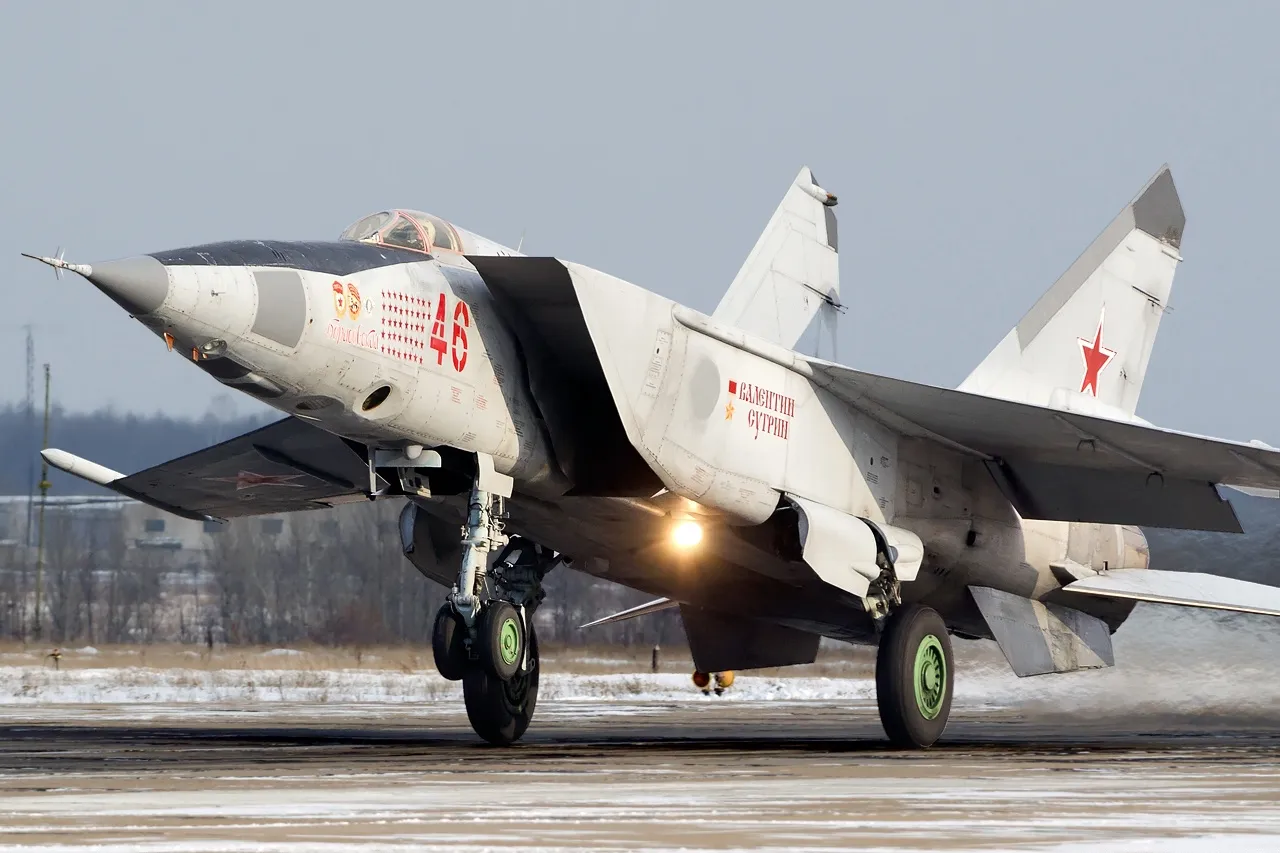
The Mikoyan-Gurevich MiG-25, NATO reporting name Foxbat, is a Soviet interceptor and reconnaissance aircraft built by Mikoyan-Gurevich (Mikoyan) that first flew on 6 March 1964. It was designed to intercept high-speed, high-altitude American bombers and, in reconnaissance form, to fly fast enough and high enough to be effectively uninterceptable. 1,186 were built between 1964 and 1984, and the type is retired, with no air force listing it in service as of 20261.
Design and development
Soviet Air Defence Forces requirements, issued from 1958, called for an interceptor able to reach 3,000 km/h and 27 km altitude to counter anticipated American bombers such as the B-70 Valkyrie; development began in 1959 at OKB Mikoyan-Gurevich, before Soviet intelligence learned of the American Mach 3 A-12 reconnaissance aircraft. Engineers rejected variable-sweep wings, underwing engine nacelles and VTOL capability, settling on two turbojets mounted side by side. Titanium would have been the ideal airframe material, but welding difficulties with thin titanium structures led the designers to a nickel-steel alloy instead, cheaper and easier to weld; the finished aircraft was about 80% nickel-steel, 11% aluminium and 9% titanium1.
The reconnaissance prototype, the Ye-155-R1, made the type’s first flight on 6 March 1964, and the interceptor prototype, the Ye-155-P1, followed on 9 September 1964. The aircraft made its public debut at the Domodedovo air show on 9 July 1967. After Soviet pilot Viktor Belenko defected with a MiG-25P to Japan in 1976, Western analysts who examined the aircraft found hand-welded construction with non-flush rivets in drag-critical areas and vacuum-tube rather than solid-state avionics1.
Specifications
The production MiG-25 is 23.82 m long with a wingspan of 14.01 m and a maximum take-off weight of 36,720 kg. It is powered by two Tumansky R-15B-300 afterburning turbojets, giving a cruise speed of about 2,500 km/h, Mach 2.35, with partial afterburner; operational top speed was limited to Mach 2.83 (2,743 km/h) because the engines tended to overspeed and overheat beyond that, causing irreplaceable damage. Its range is 1,860 km at Mach 0.9 (1,630 km at Mach 2.35), against a ferry range of 2,575 km; combat radius is only 300 km. The aircraft carries one pilot, or two in the MiG-25PU trainer variant1.
The design traded manoeuvrability for speed and altitude: it was rated for a maximum of 2.2g with full fuel and an absolute limit of 4.5g, and one aircraft that inadvertently pulled 11.5g in low-altitude training was permanently deformed. The same airframe set altitude and speed records: a re-engined Ye-266M reached an absolute altitude of 37,650 m in a zoom climb on 31 August 1977, and a MiG-25 averaged 2,981.5 km/h over a 500 km closed circuit on 5 October 19671; several of its records still stand.
Variants
The interceptor line ran from the MiG-25P (460 built, 1971-1982) with Smerch-A radar and four R-40 missiles, to the MiG-25PD (104 built, 1978-1984) with Sapfir-25 radar and look-down/shoot-down capability; existing MiG-25Ps were retrofitted to the same standard as the MiG-25PDS. Reconnaissance variants included the MiG-25R day-reconnaissance aircraft and the MiG-25RB reconnaissance-bomber, which added a bombing capability of eight 500 kg bombs, alongside electronic-reconnaissance versions such as the MiG-25RBV, RBT, RBK, RBF, RBS and RBSh. Two-seat conversion trainers were built as the MiG-25RU and MiG-25PU, and a defence-suppression variant armed with anti-radiation missiles flew as the MiG-25BM1.
Operators and service
The Soviet Union was the largest operator, flying the type in both its Air Defence Forces and Air Forces, and sent reconnaissance variants to Egypt between March 1971 and July 1972 for about 20 sorties over Israeli-held Sinai in pairs at maximum speed and high altitude, between 17,000 and 23,000 m. Syria ordered 30 MiG-25PD interceptors, 5 trainers and 8 MiG-25RB reconnaissance aircraft by 1981; Israeli F-15s shot down three of its MiG-25s between 1981 and 1982, and the Israeli Air Force destroyed the remaining Syrian aircraft after the Assad regime collapsed in December 20241.
Iraq flew the type through two wars: in the Iran-Iraq War its MiG-25s claimed more than 15 Iranian aircraft while losing only one in air combat, with Colonel Mohammed Rayyan credited with 10 kills; in the Gulf War an Iraqi MiG-25PDS shot down a US Navy F/A-18 on 17 January 1991, two Iraqi MiG-25s were shot down by USAF F-15s two days later, and a MiG-25 evaded ten AIM-7 Sparrow missiles in a separate engagement. India flew 6 MiG-25RBK and 2 MiG-25RU aircraft from 1981, covertly named “Garuda,” using them for reconnaissance over Pakistan during the Kargil War before retiring the type in May 2006; in May 1997 an Indian MiG-25RB flew faster than Mach 3 over Pakistan. Algeria was the first foreign operator, acquiring at least 36 aircraft from the late 1970s and using them for long-range reconnaissance over Western Sahara and the Mediterranean before officially retiring the type in July 2022. Libya imported 96 aircraft in the 1970s and 1980s, and smaller fleets served with Bulgaria, Belarus, Ukraine, Kazakhstan, Armenia and Turkmenistan1.
Safety record
The MiG-25’s speed came with limits that caused losses outside combat. One flight over the Sinai in 1971 at Mach 3.2 resulted in complete engine failure, and an Indian MiG-25RBK crashed on 3 August 1994. A MiG-25PU crashed near Zintan, Libya, on 6 May 2015 during civil war operations1.
Similar aircraft
- Lockheed SR-71 Blackbird: the American Mach 3 reconnaissance aircraft whose anticipated threat shaped the MiG-25’s design.
- Mikoyan MiG-31: the aircraft’s successor, developed from the same basic layout with improved radar and look-down/shoot-down capability.
- McDonnell Douglas F-15 Eagle: the American fighter that shot down several MiG-25s in Syrian and Iraqi service.
_fA8XS.webp)

_2dTk34.webp)
_ZfgbMz.webp)