Contents
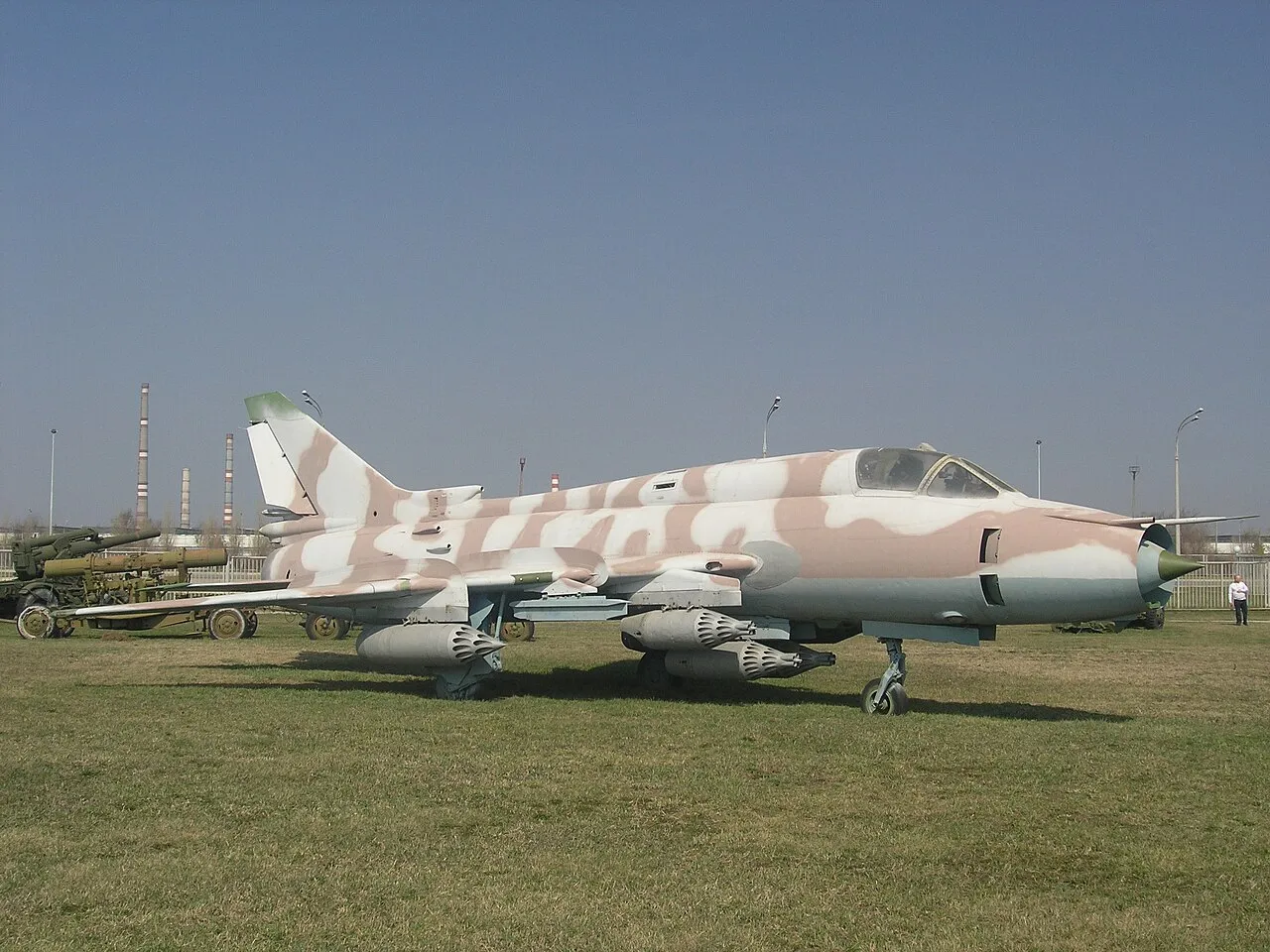
The Sukhoi Su-17, NATO reporting name Fitter, is a variable-sweep wing fighter-bomber developed for the Soviet military1. To improve the range and performance of the Su-7, Sukhoi fitted it with pivoting swing-wings2 to produce the Su-17. It was designed as a fighter-bomber, but used mostly as a bomber, and its export versions were designated Su-20 and Su-223.
Design and development
Shortly after the Su-7 entered service, the Sukhoi Design Bureau was ordered to develop a modernisation programme, aimed mainly at updating its avionics and take-off and landing characteristics, and adopted variable-geometry wings. The demonstrator, the S-22I, was converted from a production Su-7BM, with movable outer wing segments that could be swept to 28°, 45° or 62°1. It first flew on 2 August 1966. Western sources originally believed the Su-17 was nothing more than an experimental aircraft, a crude attempt to test variable-geometry wing technology. Instead, the design proved so successful2 that the Soviet Union went ahead with a production model, the Su-17M ‘Fitter-C’.
Serial production started at the Yuri Gagarin Aviation Factory, now KnAAPO, in 1969, and the type was produced until 1990, with 2,867 built1. It has one turbojet engine in the fuselage and a circular air intake in the nose, and a prominent dorsal spine3 runs from the cockpit to the tail fin.
Specifications
The final production version, the Su-17M4, is 19.02 m long, and its wings span 13.68 m spread and 10.02 m swept. Its maximum take-off weight is 19,430 kg1. Power comes from one Lyul’ka AL-21F-3 afterburning turbojet giving 110.3 kN with afterburner2.
The ‘Fitter-K’ models were optimized for high performance during low-level strike missions2. The Su-17M4 lost the inlet cone control system, which restricted the maximum allowable flight speed to Mach 1.75. Its combat range is 1,150 km on a hi-lo-hi attack with a 2,000 kg warload1, and its ferry range 2,300 km.
The aircraft is flown by one pilot. It carries two 30-mm NR-30 cannons with 80 rounds each and has eight to ten external hardpoints2. Among its weapons FAS lists the TN-1000 nuclear bomb3.
Variants
- Su-17M ‘Fitter-C’: the production model, with a more powerful and fuel efficient engine and an improved navigation and attack system. Its export version, the Su-20, had less sophisticated avionics2.
- Su-17M2 ‘Fitter-D’: an attack model with a longer nose housing a new nav/attack system and laser rangefinder. Its export model, the Su-22, was sold to Angola, Libya, and Peru2.
- Su-17UM ‘Fitter-E’: a two-seat trainer based on the Su-17M2 with a drooped nose and only one cannon.
- Su-17M3 ‘Fitter-H’: with its export versions, the most numerous variant, with almost 1,000 built1.
- Su-17M4 ‘Fitter-K’: the final production version, which first flew on 19 June 19801; its export version, the Su-22M4, was delivered to Afghanistan, Czechoslovakia, East Germany, Poland, and Vietnam2.
- Su-17M5: a proposed upgrade with a fixed wing, new avionics and an AL-31F turbofan that was not built1.
Operators and service
The 523rd Aviation Regiment, of the Far East Military District, was the first unit to receive the Su-17. Soviet aircraft flew in the Afghanistan War of 1979–19892. The Russian Air Force retired its last Su-17M4 in 19981, along with its MiG-23s and MiG-27s.
The combat record compiled by Aerospaceweb includes the Iran-Iraq War of 1980–1988, the Gulf of Sidra in 1981, where Libyan aircraft were shot down by US F-14s, the 1992 attack on a US C-1302 by Peru, and the Cenepa War of 1995. The Polish Air Force operated 90 Su-22M4s and 20 Su-22UM3Ks, and its Su-22s were retired in September 20251.
As of 2026, 20 Su-22s remained in service in Vietnam and 15 aircraft remained operational in Yemen. US Central Command released footage on 3 March 20261 showing two Iranian Su-22s destroyed on the ground by the United States.
Safety record
On 19 August 2003, a Polish Su-22M4K was shot down by friendly fire from a Polish 2K12 Kub battery during an exercise; the pilot ejected and was rescued. On 19 February 2013, a Yemeni Su-22 on a training mission crashed into Sanaa, killing 12 civilians1.
Similar aircraft
- Sukhoi Su-7: the fixed-wing Su-7B3 from which the swing-wing Su-17 was developed.
- Mikoyan MiG-27: another variable-sweep ground-attack aircraft, based on the MiG-23 fighter and powered by a Tumansky R-29-B-300 afterburning turbojet4 rather than the Su-17M4’s AL-21F-3.
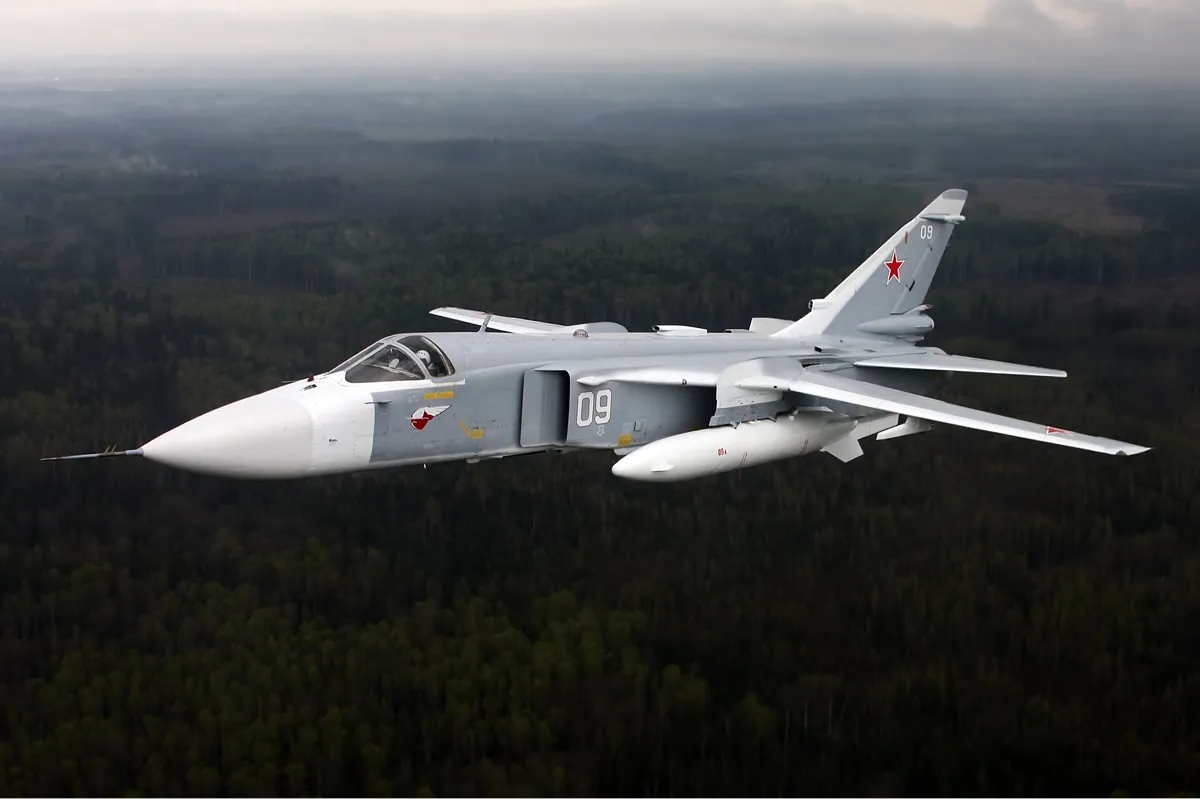
- Sukhoi Su-24: also a swing-wing Sukhoi, but with twin engines and side-by-side seating for its crew of two5.