Contents
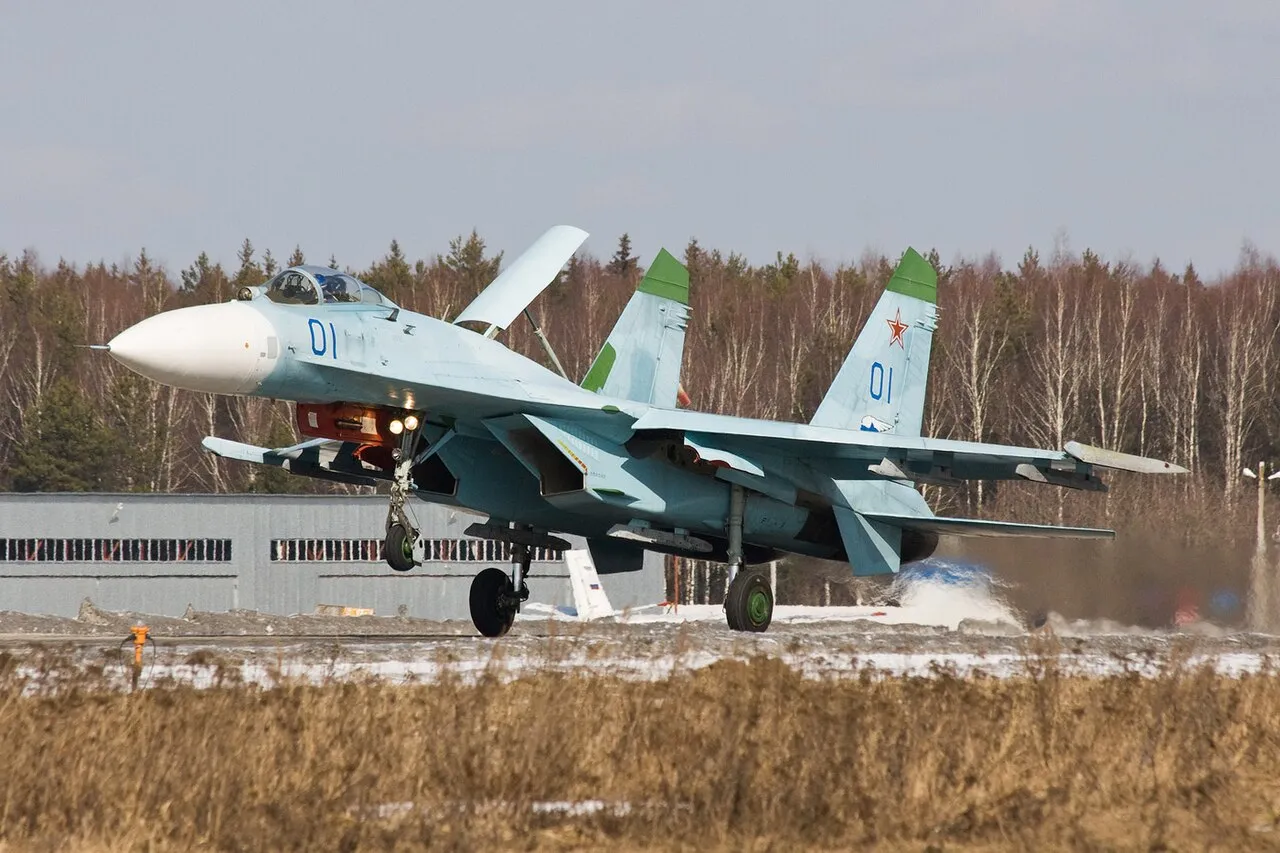
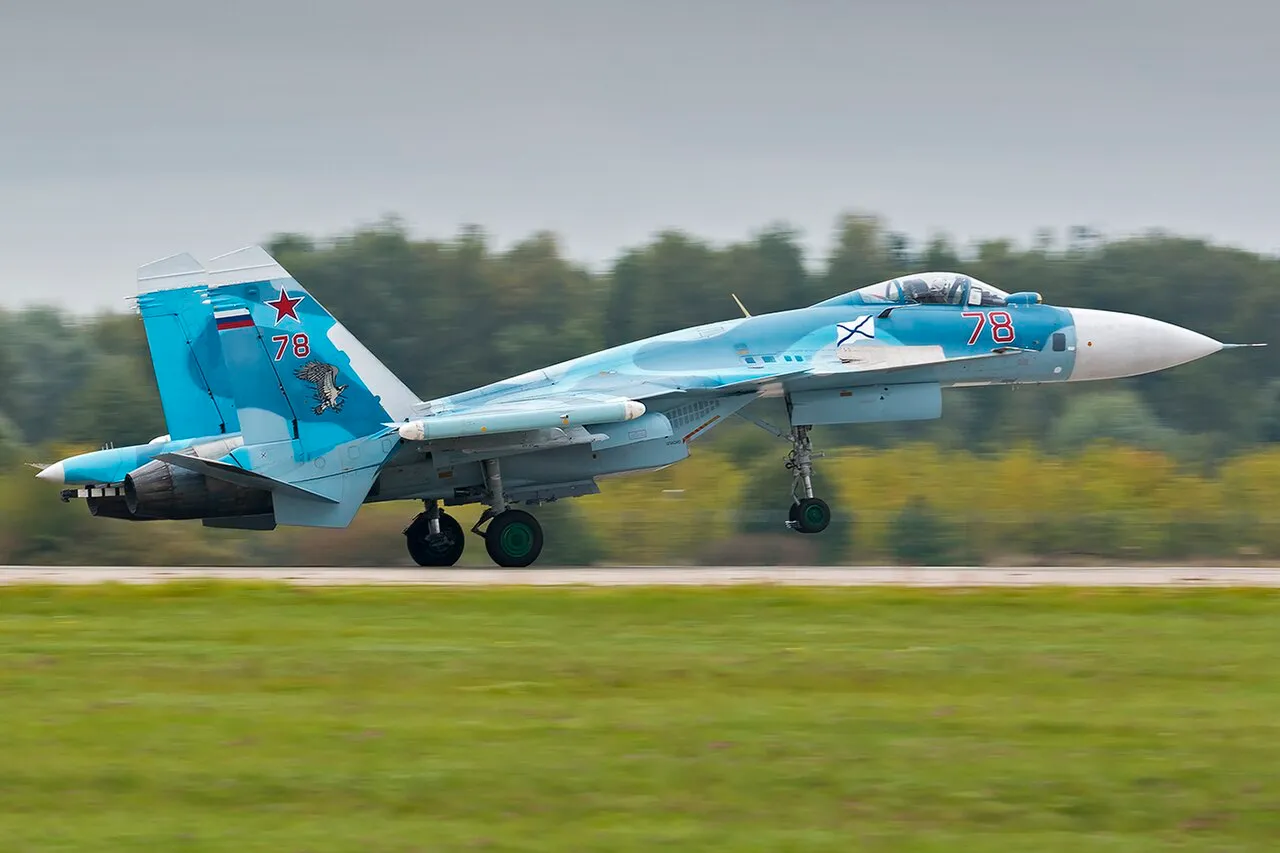
The Sukhoi Su-33 is a multipurpose carrier-based CTOL fighter, designed by Sukhoi and manufactured by Komsomolsk-on-Amur Aircraft Production Association. Derived from the land-based Su-27, it was initially known as the Su-27K. Its builder lists its missions as gaining air superiority and carrier antiaircraft defence, destroying aircraft, helicopters and anti-ship missiles and striking ground and sea targets with missiles and bombs1. In 2017 United Engine Corporation announced it had resumed engine production for all remaining 18 Su-33 fighters2.
Design and development
During the 1970s the Yakovlev Yak-38, then the Soviet Navy’s only operational carrier-based fixed-wing combat aircraft, was found unable to undertake its role due to limited range and payload. Conceptual designs of the Su-27K commenced in 1978, and on 18 April 19842 the Soviet government instructed Sukhoi to develop an air defence fighter, while Mikoyan was ordered to build a lighter multirole fighter. Full-scale design started as the T-10K under Konstantin Marbyshev. Pilots for the new carrier trained at a new establishment in Crimea named NITKA, where a take-off ramp was installed to ensure the Su-27K and the rival MiG-29K could operate from carriers.
Sukhoi gave the naval aircraft a reinforced structure and undercarriage to withstand the stress of non-flare landings, and KNAAPO lists reinforced landing gear struts and an arresting hook1 among its main features. The leading edge slats, flaperons and other control surfaces are enlarged for more lift and manoeuvrability at low speeds, and the wings and stabilators fold so the carrier can hold more aircraft. The type also has canards that shorten the take-off distance2, a rear radome shortened and reshaped so it does not strike the deck in high-alpha landings, and a twin nose wheel.
The first Su-27K prototype, piloted by Viktor Pugachyov, made its maiden flight on 17 August 1987 at the NITKA facility. Pugachyov, flying the second prototype, became the first Russian to land conventionally aboard a carrier on 1 November 1989, and the next three weeks brought 227 sorties and 35 deck landings. By 1994 it had passed the State Acceptance Trials2.
Specifications
Sukhoi gives the Su-33 a length of 21.19 m and a wingspan of 14.7 m, which drops to 7.4 m with wing panels and foreplanes folded; it stands 5.9 m tall. Maximum take-off weight is 33,000 kg, with up to 6,500 kg of ordnance3. KNAAPO quotes a range of 3,000 km without refuelling, a top speed at altitude of 2,300 km/h, an operating ceiling of 17,000 m and a landing approach speed of 240 km/h1. Air Force Technology gives an empty weight of 18,400 kg, a wing area of 62.0 m² and a rate of climb of 325 m/s4.
Power comes from two AL-31F3 engines, each giving 125.5 kN (28,200 lbf) with afterburner2. KNAAPO describes it as a single-seat carrier-based fighter. The aircraft carries a 30-mm gun and rockets and bombs on 12 external hard points, and Air Force Technology lists R-27 and R-73 air-to-air missiles4. Its systems can track up to 10 aerial targets at once, and with a suspended refuelling pod it can refuel fighters of a similar type1.
Variants
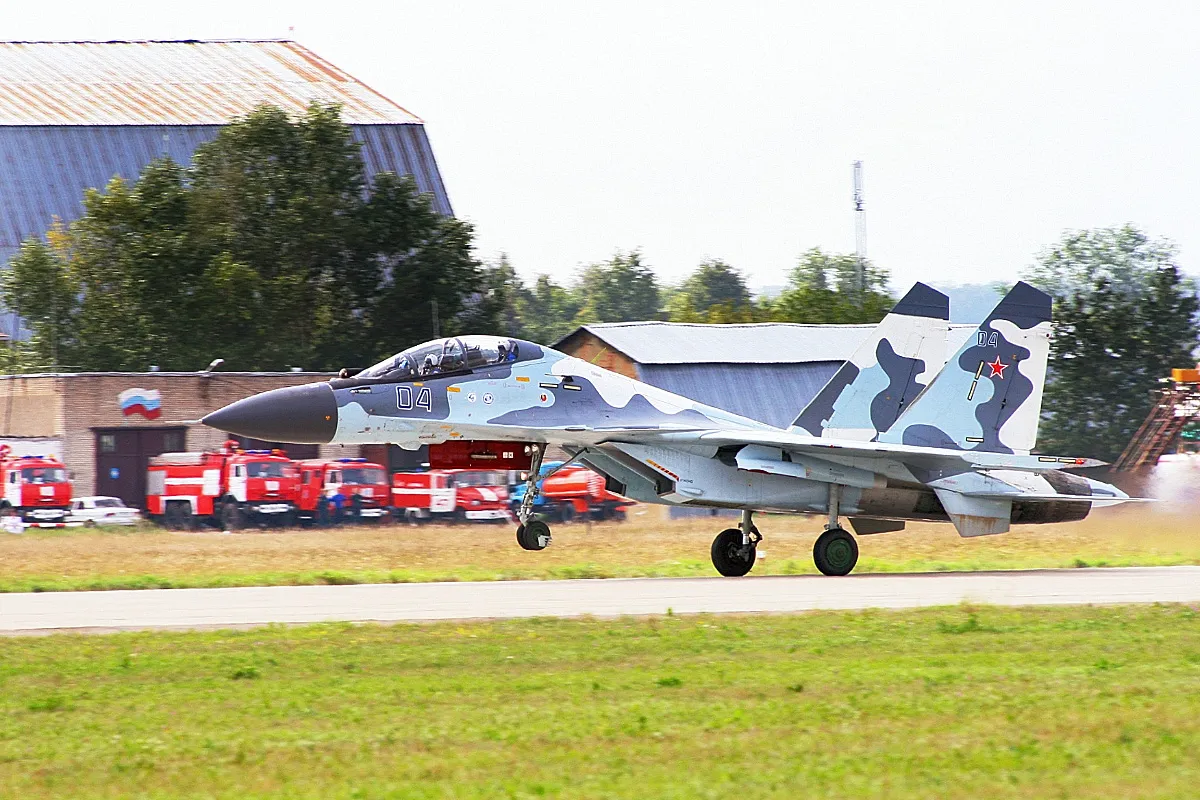
The twin-seat Su-33UB, at first named Su-27KUB, made its first flight in April 1999, flying 40 minutes near Ramenskoye Airport with Pugachyov and Sergey Melnikov at the controls. It seats its crew of two side by side and has a revised forward fuselage and leading edge slats with bigger wings and stabilators. After the break-up of the Soviet Union and the downsizing of the Russian Navy, only 24 aircraft were produced4; had three more carriers been commissioned, 72 production airframes2 would have been built.
Operators and service
As of 2022 the Russian Navy is the only operator. The Su-27K was introduced in the mid-1990s, and Admiral Kuznetsov sailed in the Mediterranean from December 1995 to March 1996 with 13 Su-27Ks aboard. The aircraft officially entered service on 31 August 19982 as the Su-33, with the 279th independent Shipborne Assault Aviation Regiment at Severomorsk-3 as its first unit.
In 2009 it was announced that the Russian Navy would buy MiG-29Ks to replace its fleet of about 19 Su-33s. In 2015 the head of naval aviation said a second fighter regiment would augment the current force with the MiG-29Ks, and the existing Su-33s were to be refurbished. On 15 November 2016, Su-33s flying from Admiral Kuznetsov struck ISIL and Al-Nusra targets in Idlib and Homs provinces with 500 kg precision ammunition, the type’s first combat use. India had planned to buy the Su-33 for INS Vikramaditya but chose the MiG-29K because of the Su-33’s outdated avionics2.
Safety record
On 17 July 2001 a Russian Navy Su-33 crashed during an air show in Russia’s Pskov Region, killing its pilot, Major-General Timur Apakidze. On 5 September 20052 a Su-33’s arresting cable broke after a landing on Admiral Kuznetsov in the Northern Atlantic; the pilot ejected and was recovered.
On 3 December 2016 a Su-33 crashed at its second attempt to land on Admiral Kuznetsov, and the Russian Ministry of Defence said the arresting wire snapped and failed to stop the aircraft. The pilot ejected and was picked up by a rescue helicopter. Less than three weeks earlier, a MiG-29K from the same carrier had crashed on 14 November5.
Similar aircraft
- Sukhoi Su-27: the land-based parent. The Su-33 adds a strengthened undercarriage, folding wings, new canards and a twin nose wheel2.
- Grumman F-14 Tomcat: an American carrier fighter with a tandem two-seat cockpit and a variable-sweep wing6, where the Su-33 is a single-seat carrier-based fighter1.
- Mikoyan MiG-29K: the Su-33’s rival on Russian carriers. The Su-33 is larger and more expensive, but the MiG-29K carries more air-to-ground munitions2.