Contents
The Boeing X-45 is a tailless, stealth-shaped drone the Smithsonian calls the first modern UAV built for combat strikes. Boeing’s Phantom Works division built it for DARPA, and the programme moved under joint US Air Force and Navy management1 in October 2003 as the Joint Unmanned Combat Air Systems (J-UCAS) initiative, built to prove the technology instead of fielding it. Boeing’s earlier Bird of Prey demonstrator validated the stealth design and build methods2 the X-45 then used.
Design and development
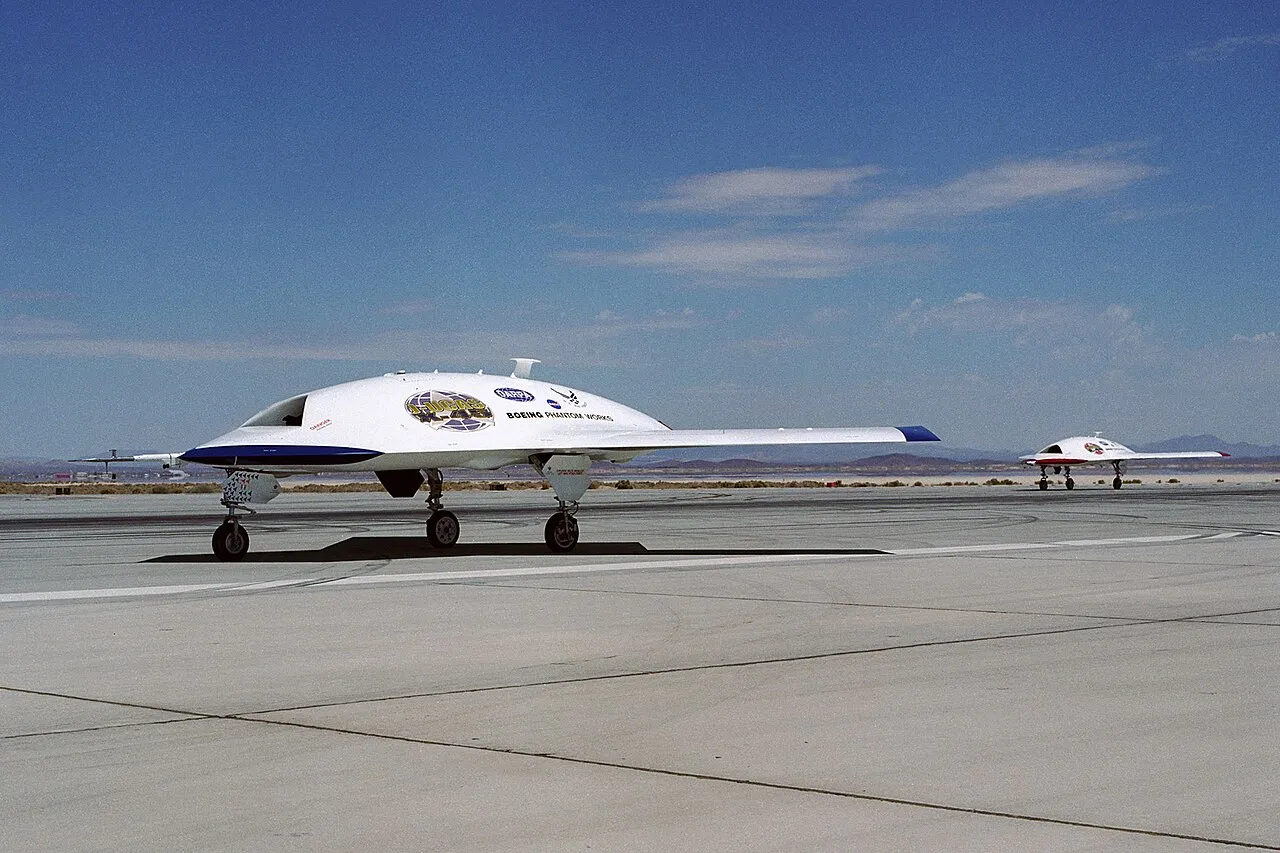
Phantom Works completed the first of two X-45A demonstrators in September 2000, and only those two X-45A airframes were ever built. The Smithsonian dates the type’s first flight to May 2002, specifically 22 May, with the second airframe’s first flight following that November. It had retractable landing gear and a composite skin1. The airframe blends its fuselage into a swept, lambda-shaped flying wing2 with a low dorsal intake and no vertical tail, a configuration similar to Northrop’s flying-wing designs, using split ailerons as air brakes and yaw-axis thrust vectoring in place of a rudder; ground-based pilots executed the higher-level decisions, but the mechanical flying was autonomous, with no pilot or pilot-related equipment aboard.
Testing progressed through a series of public milestones. The Smithsonian credits the programme’s X-45As with the first autonomous flight of a combat-capable drone and the first weapons release from one, achieved on 18 April 2004, when an X-45A hit a ground target with an inert 250 lb precision-guided munition at Edwards Air Force Base. On 1 August 2004, a single ground-based pilot controlled two X-45As in flight at the same time for the first time; the Smithsonian separately credits the pair with the first autonomous, multi-vehicle coordinated flight of the programme. On their 50th flight2 the pair autonomously determined which aircraft held the optimum position to attack a target, and the ground-based pilot then authorised the attack on a simulated anti-aircraft emplacement. Flight testing concluded successfully in August 20051.
DARPA then moved to a larger, longer-range design: it awarded Boeing $767 million for the X-45C in October 2004, followed by a further $175 million the next July to continue the programme and implement autonomous aerial refuelling technology. Boeing began assembling the first X-45C at its St. Louis facility in June 2004, with completion planned for 2006 and a first flight for 2007; it never flew under the J-UCAS programme, which the Air Force ended2 on 2 March 2006. Boeing said its intended missions may include3 suppression of enemy air defences, strike, electronic attack, and intelligence, surveillance and reconnaissance.
Specifications
The X-45A was 8.03 m long with a 10.31 m wingspan and 1.13 m tall, with an empty weight of 3,629 kg1. It flew on a single Honeywell F124-GA-100 turbofan, cruising at about 987 km/h, with a service ceiling of about 12,000 m and a combat range of about 2,400 km2.
The planned X-45C was considerably larger: 39 ft (about 11.9 m) long, with a 49 ft (about 14.9 m) wingspan and a cruise speed of Mach 0.803. It grew out of the larger X-45B design, modified for even more fuel capacity and three times greater combat range2. The redesign extended the wing’s leading edges from nose to wingtip, closer to the B-2 Spirit’s planform, giving it more wing area.
Sensors and weapons
The X-45A carried eight hardpoints split between two internal weapons bays2, sized for Joint Direct Attack Munitions (JDAM) or the Small Diameter Bomb; the 250 lb precision-guided munition an X-45A dropped on 18 April 2004 was inert. Boeing’s 2004 description of the planned X-45C gave it a payload of eight Small Diameter Bombs, or the full range of Boeing’s JDAMs3. Neither version ever entered service, so neither was armed operationally.
Operators and combat use
The X-45 never reached an operational combat unit. It stayed a DARPA- and Air Force-funded demonstrator through to cancellation, and in 2004 Boeing said both X-45As were being flight-tested at Edwards Air Force Base3. After the Air Force ended the programme, Boeing proposed a carrier-based derivative, the X-45N, for the Navy’s unmanned combat air competition, with a first flight planned for November 2008 had Boeing been selected; Northrop Grumman’s X-47 won that competition instead, ending X-45 development for good. Boeing later funded, on its own, a separate programme called Phantom Ray, which uses the X-45C prototype vehicle2 as a test bed rather than continuing the J-UCAS demonstrator.
After flight testing ended, both X-45A demonstrators were sent to museums2: one to the National Air and Space Museum, the other to the National Museum of the United States Air Force, where it was inducted on 13 November 2006.
Variants
The flown X-45A was the initial, smaller demonstrator described above. The planned X-45B was redesigned partway through development into the larger X-45C, with even more fuel capacity, triple the combat range and three planned airframes, none of which flew before cancellation. The proposed X-45N was a carrier-based variant pitched to the Navy after the Air Force ended its funding; it was never built, as the Navy chose the competing X-47 instead. Boeing’s Phantom Ray, an internally funded programme that uses the X-45C prototype vehicle2, was planned as an unmanned flying test bed for advanced air system technologies.
Similar drones
- Northrop Grumman X-47: the rival carrier-based combat drone demonstrator that the Navy selected over Boeing’s proposed X-45N2, ending X-45 development.
- General Atomics MQ-1 Predator: an earlier, propeller-driven remotely piloted aircraft built for armed reconnaissance against critical, perishable targets4, next to the X-45’s stealth-shaped, jet-powered combat demonstration role2.
- General Atomics MQ-9 Reaper: a turboprop-powered successor to the Predator built for persistent surveillance and strike with an endurance of over 27 hours, and acquired by several air forces besides the US5 where the X-45 never left the demonstrator stage.
_ZbySau.webp)
_ZnEDr2.webp)