Contents
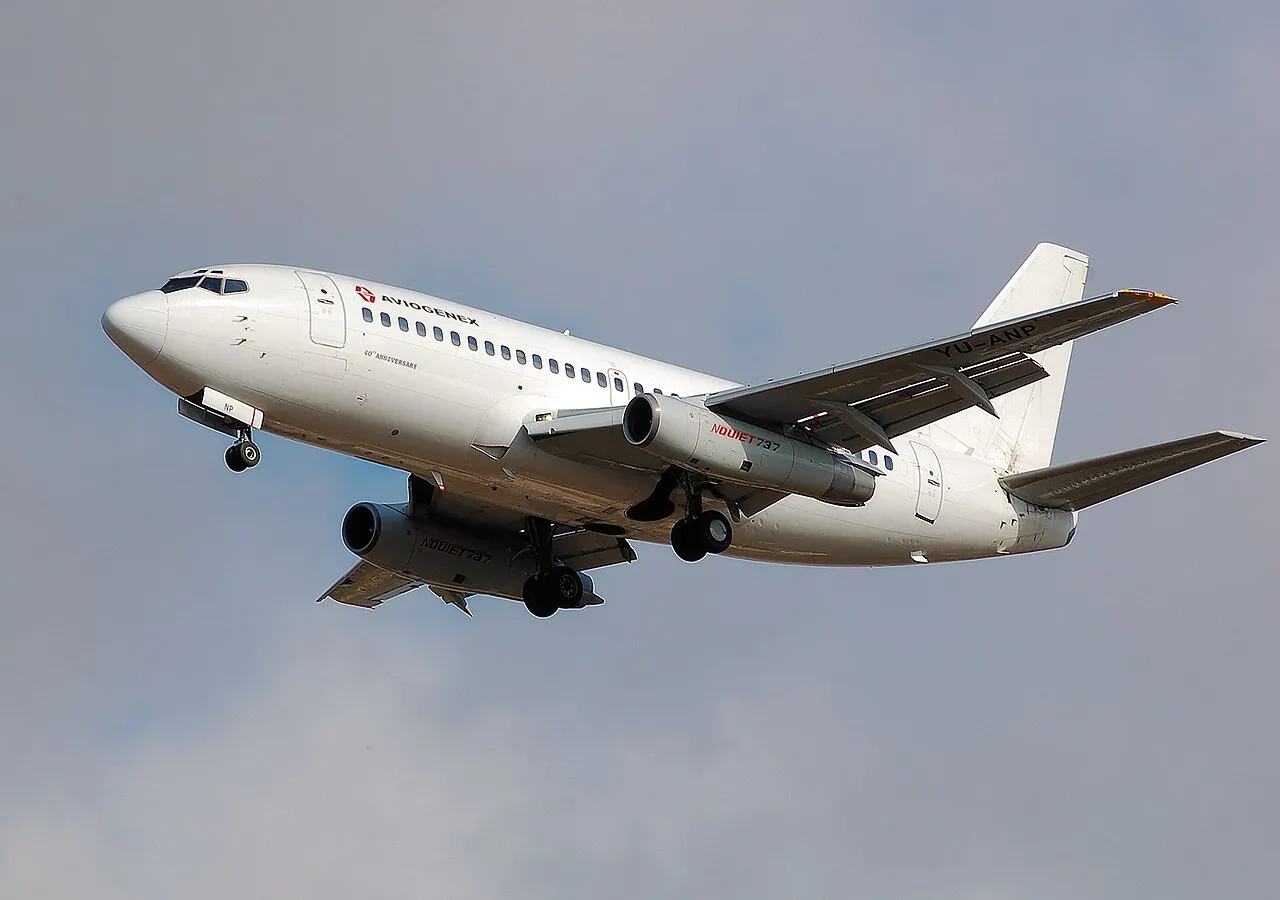
The Boeing 737 is an American narrow-body aircraft built by Boeing, a twinjet developed to supplement the Boeing 727 on short and thin routes. Boeing had delivered 12,739 of the 17,641 ordered by September 20261. For the latest generation, the 737 MAX, Boeing says more than 100 customers have placed firm orders for approximately 7,0002 airplanes.
Design and development
Preliminary design work began on 11 May 1964 for a fifty to sixty passenger airliner. The board approved the launch on 1 February 1965; Lufthansa ordered 21 on 19 February. The first 737-100 first flew in April 1967 and entered service in February 1968 with Lufthansa, and the lengthened 737-200 entered service in April 19681.
Of the second-generation Classic series (-300, -400 and -500), 1,988 were delivered between 1984 and 2000. The third-generation Next Generation series (-600, -700, -800 and -900) was launched late 1993, and launch customer Hapag-Lloyd received the first 737-800 in April 19981.
Boeing’s board approved the launch of the new engine variant on 30 August 2011, based on order commitments for 496 airplanes from five airlines and powered by CFM International LEAP-1B engines. The same announcement said Next-Generation 737s were up to 7 percent more fuel-efficient than those delivered in 1998. At launch Boeing expected the new model’s fuel burn to be 16 percent lower than the competitor’s current offering, with deliveries scheduled to begin in 20173. Named the 737 MAX, it first flew on 29 January 2016 and was FAA-certified on 8 March 2017, after a test program with four airplanes; the 737 MAX 8 was the first in the family to be developed. At certification Boeing called it the fastest-selling airplane in Boeing history, with more than 3,600 orders from 83 customers4. The first MAX 8 went to Malindo Air, which flew it into service on 22 May 20171.
Specifications
The original 737-100 was 29 m long, with a 50,000 kg MTOW and 2,850 km range1. At the other end of the family, the 737-10 is 43.8 m long with a maximum takeoff weight of 89,760 kg, while the 737-7 has a range of up to 7,040 km and the 737-10 up to 5,740 km2.
Wingspan was 28.35 m on the 737-200 and 35.79 m on the Next Generation with winglets5; every 737 MAX model spans 35.9 m and stands 12.3 m tall. The first three generations used JT8D, then CFM56-3, then CFM56-7 turbofans1, and the MAX uses LEAP-1B engines by CFM International. Boeing credits the MAX with a 20% reduction in CO2 emissions and fuel use and says the 737-8 has a 50% smaller noise footprint than the 737-8002.
Variants
In two classes, MAX seating runs from 135 on the 737-7 to 210 on the 737-10, which takes up to 230 seats. Boeing aims the 737-7 at new routes and emerging markets and the 737-10 at the largest passenger capacity on high-demand routes2. Earlier, Boeing offered the 737-200C combi and the 737-200QC quick-change1 for conversion between passenger and cargo use.
Military versions include the T-43, a modified 737-200 the US Air Force ordered, and the C-40 Clipper, a military version of the 737-700C. The P-8 Poseidon is a multimission maritime patrol aircraft sharing 86% commonality with the Next-Generation 7376; for the US Navy it is the replacement for the P-3C Orion7. The 737 AEW&C is an airborne early warning and control version of the 737-7001, and Boeing Business Jets offers a BBJ 737 Max8 for VIP travel.
Operators and service
Boeing says more than 1 million passengers fly on a 737 MAX every day, and a single-type MAX fleet shares the same pilots, flight attendants and mechanics2. In 2013 the global fleet had completed more than 184 million flights over 264 million block hours1.
The 737 was the best-selling commercial aircraft until October 20191, when the competing Airbus A320 family surpassed it.
Safety record
Civil aviation authorities grounded the 737 MAX in March 2019 after two hull-loss crashes with 346 deaths. Boeing suspended MAX production from January 2020 until 27 May 2020. The FAA cleared the MAX to return to service on 18 November 20201.
Similar aircraft
- Airbus A320 family: the Airbus single-aisle rival, first introduced in 19881, that competed with the 737 Classic, Next Generation and MAX.
- Airbus A220: a newer, smaller family that competes against the smaller capacity end of the 737 variants1.
- McDonnell Douglas DC-9: the 737’s main early competitor, followed by its MD-80/MD-90 derivatives1.
_ZbySau.webp)
_ZnEDr2.webp)