Contents
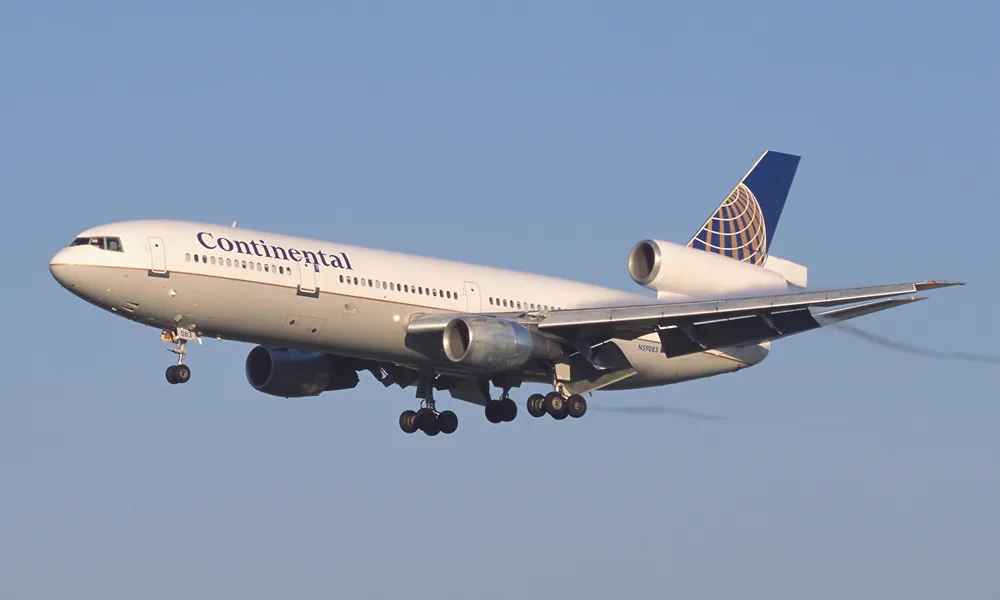
The McDonnell Douglas MD-11 is an American widebody trijet, first manufactured by McDonnell Douglas and later by Boeing, and the largest trijet ever built. It keeps the basic trijet configuration of the DC-101, two engines under the wings and a third at the base of the fin, with General Electric CF6-80C2 or Pratt & Whitney PW4000 turbofans. Many passenger MD-11s were later converted to freighters, and in November 2025 FedEx and Western Global Airlines operated MD-11 freighters2, as did UPS.
Design and development
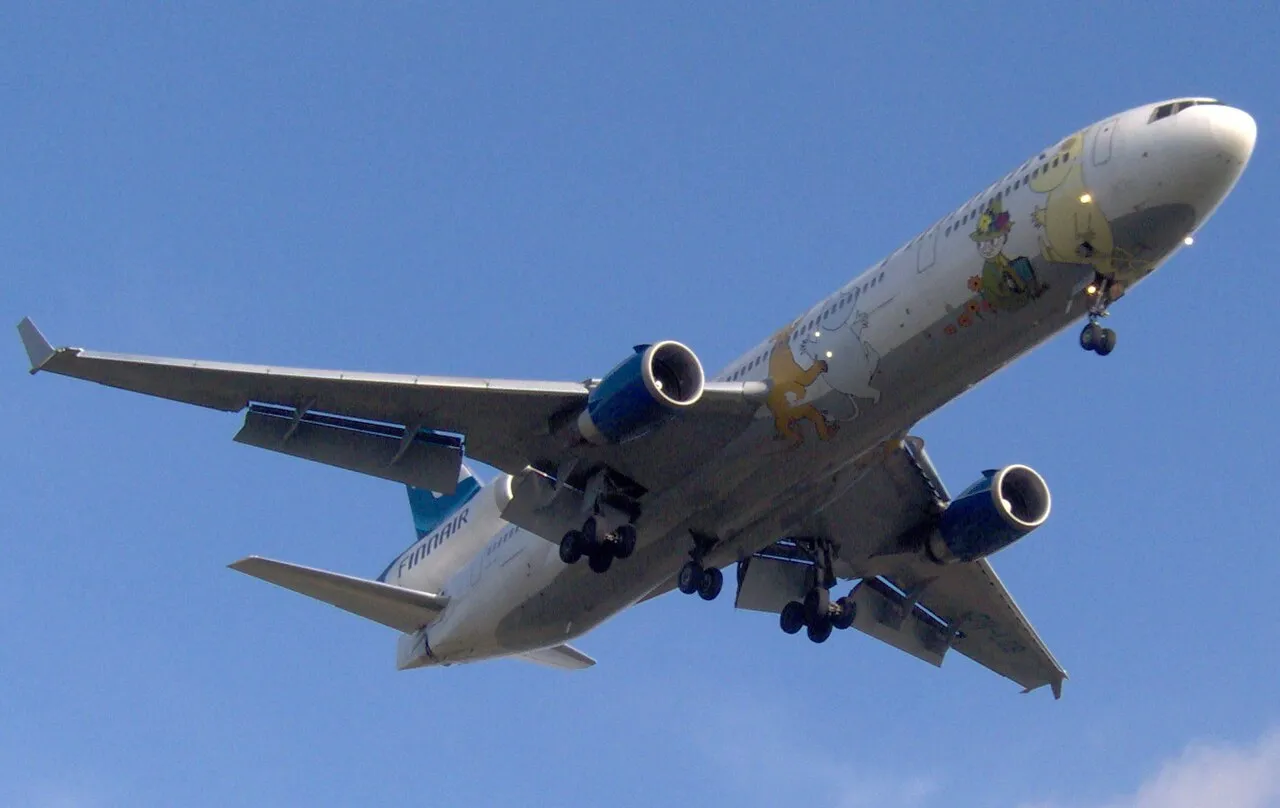
McDonnell Douglas launched the MD-11 on 30 December 1986 with commitments for 52 firm orders and 40 options, and the prototype made its maiden flight on 10 January 1990. FAA certification was granted on 8 November 19901; Finnair received the first aircraft on 7 December and flew the first revenue service on 20 December, from Helsinki to Tenerife.
The airframe is based on the DC-10 but has a stretched fuselage, a longer wingspan with winglets, refined airfoils, new engines and more composite parts, and its horizontal tail is 30% smaller than that of the DC-10-30. A two-crew glass cockpit1 with six 8-inch CRT displays removed the need for a flight engineer.
The aircraft failed to meet its advertised range and fuel-burn targets, and Singapore Airlines cancelled its order for 20 MD-11s in favour of 20 Airbus A340-300s. Rival twinjets such as the Boeing 767, Boeing 777 and Airbus A330 took the orders instead. After McDonnell Douglas merged with Boeing in 1997, the combined company limited production to freighter variants1 to avoid competing with the 767 and 777; McDonnell Douglas had once projected sales of more than 300 aircraft, but only 200 were built.
Specifications
Compared with the DC-10, the MD-11’s fuselage is stretched by 11% to 61.6 m in its General Electric-powered form, room for 298 passengers in three classes over a range of up to 7,130 nautical miles, and its maximum take-off weight rises by 14% to 286 tonnes. To improve fuel efficiency, a fuel-ballast tank in the horizontal stabilizer1 moved the centre of gravity farther aft in cruise than on other airliners and allowed a much smaller tailplane than the DC-10’s. Those design choices, with one of the highest wing loadings of any airliner, give standard landing speeds 10–20 knots faster than comparable aircraft and reduce the margin for error during take-off and landing.
Variants
Five variants were built: 131 passenger MD-11s1, 53 MD-11F freighters, 6 MD-11CF convertible freighters, 5 MD-11C combis, all for Alitalia, and 5 extended-range MD-11ERs. The MD-11F, the last version in production, carries a maximum payload of 90,787 kg on 26 main-deck pallets. Boeing and its affiliates also convert used passenger aircraft into MD-11BCF freighters.
Operators and service
Most airlines that ordered the MD-11 for long-haul passenger flights had replaced it with A330s, A340s and 777s1 by the end of 2004, and KLM operated the last scheduled passenger flight, from Montréal to Amsterdam, on 26 October 2014.
UPS, which operated one of the world’s largest MD-11 fleets, grounded its aircraft at Boeing’s recommendation after the November 2025 crash, a move affecting about 9 percent of the UPS Airlines fleet2. UPS then opted to retire its MD-11s3.
The FAA later approved Boeing’s protocol for returning the type to service, which requires airlines to replace a structural component, and FedEx put an MD-11 freighter back into commercial service for the first time since early November. After the return to service, FedEx had 29 MD-11s in its fleet and said it would keep flying them until 2032 to meet rising cargo demand. To carry out the fix it said it would ship the pylons to its maintenance hubs3 in Memphis and Indianapolis.
Safety record
As of November 2025, the MD-11 had been involved in 11 hull-loss accidents that killed 261 people. Swissair Flight 111 crashed on 2 September 19981 into the Atlantic Ocean near Halifax, Nova Scotia, killing all 229 people on board, after a fire originating from improper wiring of an in-flight entertainment system.
On 4 November 2025, UPS flight 2976, an MD-11F registered N259UP, was destroyed when it hit the ground shortly after take-off from Louisville Muhammad Ali International Airport, Kentucky, on a cargo flight to Honolulu. The 3 crew members and 11 people on the ground were killed, and 23 others on the ground were injured. Airport surveillance video stills published by the NTSB show the left engine and left pylon separating4 from the left wing.
The FAA then issued emergency airworthiness directive 2025-23-512, which barred every MD-11 and MD-11F from flying until it was inspected and corrective actions were completed. A preliminary NTSB finding identified fatigue cracks in the pylon3 holding the engine to the wing, a problem traced to a bearing. Parties to the investigation include the FAA, UPS, Boeing and GE Aerospace. As of 2026 the investigation is ongoing, and the NTSB scheduled a two-day investigative hearing for 19–20 May4 2026.
Similar aircraft
- McDonnell Douglas DC-10: the trijet the MD-11 was developed from; it is shorter, at 55.35 m1, and lacks the MD-11’s winglets and smaller tailplane.
- Airbus A340: a long-haul rival with four engines instead of three; later twinjets were more fuel-efficient than both the MD-11 and the quadjet A3401.