Contents
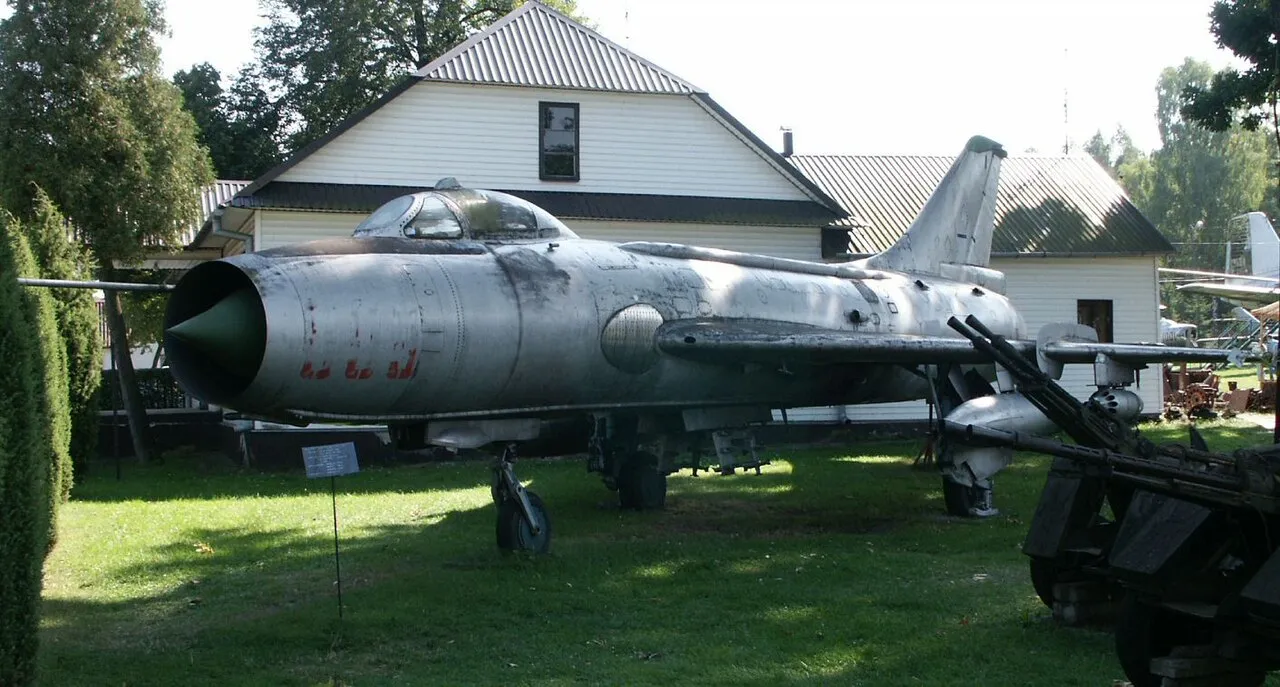
The Sukhoi Su-7, NATO reporting name Fitter-A, is a swept-wing, supersonic fighter developed by the Soviet Union in 19551. It was a Soviet supersonic fighter and fighter-bomber2 from the Sukhoi design bureau. The Federation of American Scientists describes it as a single-seat ground attack aircraft3 that was long a standard tactical fighter-bomber of the Soviet Air Force.
Design and development
The first prototype, the S-1, was designed around the new Lyulka AL-7 turbojet. It was the first Soviet aircraft with an all-moving tailplane1 and a movable inlet cone in the air intake. The prototype first flew on 7 September 19552. The Su-7 was shown to the West at the 1956 Soviet Aviation Day display at Tushino3, outside Moscow.
As a fighter the type had a short career. The first Su-7s were delivered to the Soviet air force from 1958, but only two regiments received them, and the type was phased out by the middle of the 1960s. The fighter-bomber Su-7B was more successful2 and for many years was one of the most important tactical aircraft of the Soviet air force. Its S-22 prototype first flew in March 19591, and the type entered service in 1961.
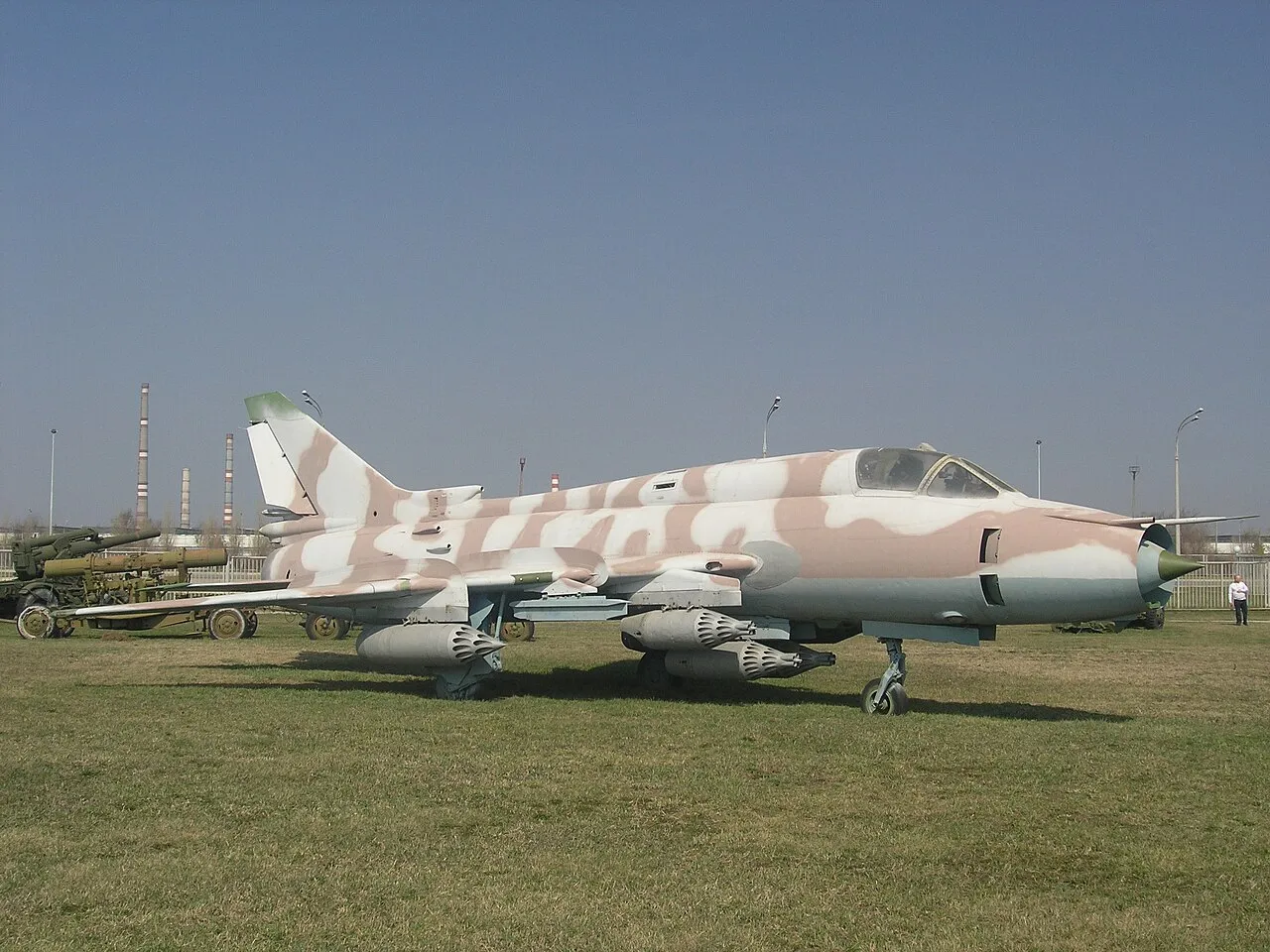
The Lyulka AL-7 engine had such high fuel consumption that even short-range missions needed at least two hardpoints for drop tanks rather than weapons. Work on better take-off and landing performance eventually resulted in the variable-geometry Su-171.
Specifications
Sukhoi’s own figures for the Su-7BKL give a length of 16.804 m and a wingspan of 9.309 m. A longer 17.38 m, with a span of 9 m3, comes from the Federation of American Scientists. The BKL has a maximum take-off weight of 15,210 kg, and every version in Sukhoi’s table uses the AL-7F-1 engine with 9,600 kg of afterburning thrust. The same table gives the BKL a top speed of 2,150 km/h and an operational ceiling of 17,600 m4.
Published range figures differ. Sukhoi gives the BKL an operational range of 1,650 km4, while the Federation of American Scientists puts the maximum range lower, at 1,449 km, falling to a combat range of 250–350 km with drop tanks3. Store norske leksikon puts the Su-7BM’s combat radius at 460 km2 with 1,500 kg of weapons and drop tanks.
The rough-field BKL has a take-off run of 950 m4, against 1,350 m for the first Su-7B. Its fixed armament is two 30 mm NR-30 guns in the wing roots, each with 70 rounds. The Su-7BM could carry up to 2,000 kg of bombs and rockets2. The jet has one engine in the body3, a circular air intake in the nose and a large bubble canopy.
Variants
- Su-7A: the only production version built as an air superiority fighter1, with 132 made from 1957 to 1960.
- Su-7B: the first ground-attack version1, delivered from 1960, with about 430 built2.
- Su-7BM: an upgraded version delivered from 1963; about 290 were built2, 66 of them for Czechoslovakia.
- Su-7BKL: the last main version, delivered from 1965, with more than 260 built2. It has skids beside the main wheels1, provision for two SPRD-110 JATO rockets and twin brake parachutes.
- Su-7BMK: a separate export version, with about 440 produced2.
- Su-7U and Su-7UMK: two-seat trainers, NATO name Moujik, with about 410 built2, the UMK for export.
In all, 1,847 Su-7s of all versions were built1.
Operators and service
The Su-7BMK went to Afghanistan, Algeria, Egypt, India, Iraq, Libya, North Korea and Syria. It flew in combat with Egypt in the 1967 Six-Day War and the 1973 Yom Kippur War2, with India in the 1971 war with Pakistan and with Iraq in the Iran–Iraq War.
India’s Su-7 squadrons, 140 aircraft in all, flew almost 1,500 offensive sorties in the 1971 war. Czechoslovakia was the first foreign operator, in 1963, and Poland flew the type from July 1964 until June 1990. Among the other users the Federation of American Scientists names are Afghanistan, Algeria, Bangladesh, the Czech Republic, North Korea and South Yemen3. In the Soviet Union, the remaining Su-7s were replaced by Su-17s and MiG-27s1 between 1977 and 1986.
Safety record
The S-1 prototype was lost in a crash on 23 November 1956, killing its pilot, I. N. Sokolov. Czechoslovakia lost 30 aircraft in accidents1 during its years of service.
Similar aircraft
- Sukhoi Su-17: the fighter-bomber based on the Su-7B with swing wings2.
- Mikoyan-Gurevich MiG-21: a similar aircraft3 whose production was given priority in 19591, so fewer than 200 Su-7As were deployed.
- Sukhoi Su-9: an interceptor that grew out of a delta-winged version of the S-21, where the Su-7 kept its swept wing.