Contents
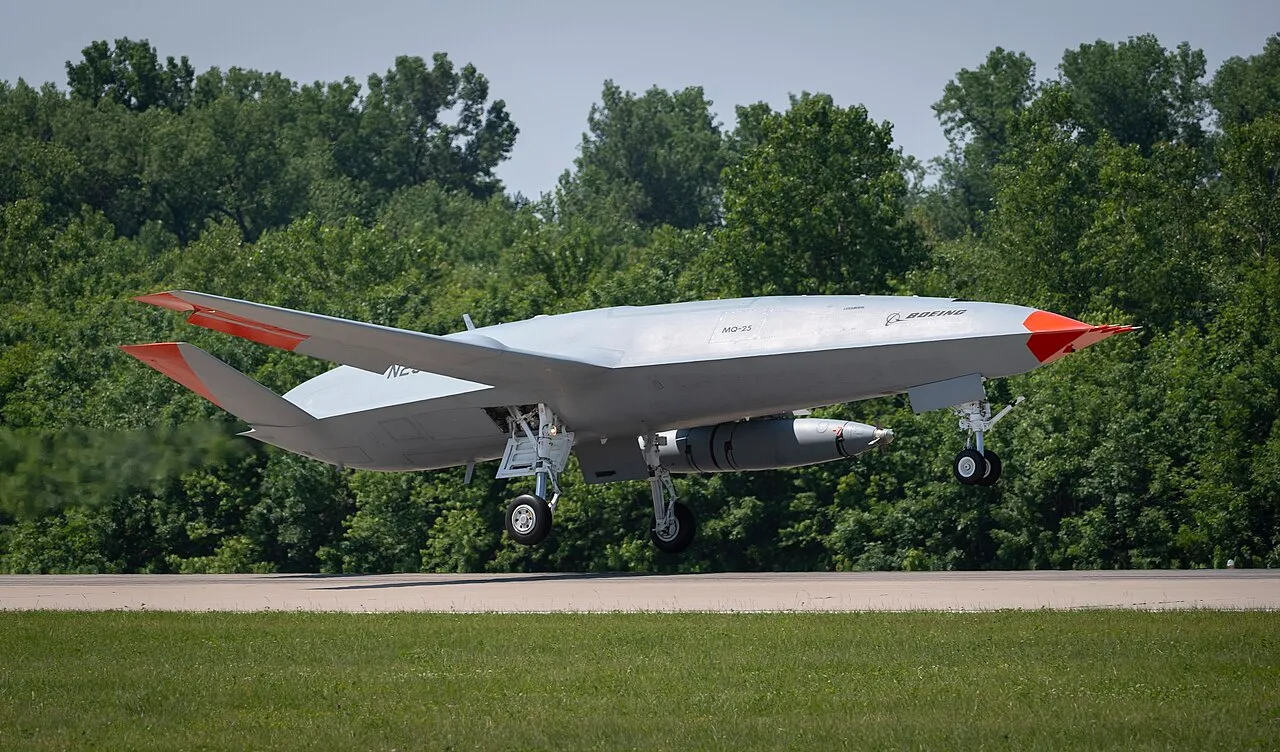
The Boeing MQ-25A Stingray is the US Navy’s first operational, carrier-based unmanned aircraft. Boeing gives its primary mission as unmanned aerial refueling to extend the range, endurance and flexibility of the carrier air wing, and says it is also equipped for intelligence, surveillance and reconnaissance missions1. Defense News reports that it will become the Defense Department’s first unmanned tanker. It is meant to take the refueling role off the Navy’s F/A-18 Super Hornets so those jets can focus on strike missions2.
Design and development
The Navy began its efforts to develop a carrier-based drone in 2006. The original Unmanned Carrier-Launched Airborne Surveillance and Strike (UCLASS) concept was a stealthy strike platform able to penetrate enemy air defenses, and in 2012 its strike requirements were diluted to create an intelligence, surveillance and reconnaissance aircraft. By 20162 the Navy had pivoted from a strike and intelligence mission to a carrier-based UAV mission. The aircraft was officially named MQ-25A Stingray in July 20163.
Boeing told The War Zone that the MQ-25 was influenced by the UCLASS program4 and built on its design elements and lessons learned. Boeing had finished building its wing-body-tail design in 2014, when UCLASS was paused, and revived it for the refueling mission. Northrop Grumman withdrew its X-47B from the competition on 25 October 20173.
On 30 August 2018, the Navy awarded Boeing $805 million for the first four engineering development model (EDM) aircraft. A contract change in April 20201 added three more, bringing the total Boeing was building to seven.
Boeing’s own T1 test aircraft made its first flight on 19 September 2019. On 7 June 2021 it became the first unmanned aircraft to refuel another aircraft, passing jet fuel to a Navy F/A-18 Super Hornet. It went on to refuel an E-2D Hawkeye in August 2021 and an F-35C Lightning II in September 2021. In December 2021 the Navy and Boeing maneuvered T1 on a Navy aircraft carrier for the first time. Boeing says T1 logged approximately 125 flight hours1 after its first flight.
In March 2025 Boeing moved the first Navy EDM aircraft into its new MQ-25 production facility at MidAmerica St. Louis Airport and started final assembly. The first operational MQ-25A taxied autonomously for the first time on 29 January 20261. The Navy’s first successful Stingray test flight came on 25 April, a year behind the service’s initial plans. In September 20263 the Navy awarded Boeing a $562 million2 contract for Lot 1 low-rate initial production.
Specifications
Boeing lists a wingspan of 22.9 m with the wings spread and 9.5 m with them folded, and a length of 15.5 m. Power comes from one Rolls-Royce AE 3007N engine1. The War Zone notes that a variant of the AE 3007 also powers the RQ-4 Global Hawk, and calls it efficient and proven4.
The airframe is less stealthy than flying wing UAVs3 but has stealthy fuselage shaping, a flush inlet that shields the engine blades from radar, and a V-tail. Boeing says it is designed to taxi, take off, fly and land autonomously1 at the push of a button.
The Navy’s goal is for the aircraft to deliver 15,000 lb (6,800 kg) of fuel3 in total to four to six aircraft at a range of 500 nautical miles (930 km). Stingrays were also intended to stay aloft for at least three launch-recovery cycles. Boeing, Rolls-Royce and the Navy were not willing or authorized4 to give The War Zone the drone’s actual range, endurance and fuel load. Boeing’s own specifications list only wingspan, length and engine1, with no maximum take-off weight.
Sensors and weapons
Boeing says the MQ-25A has state-of-the-art sensors1 and secure, interoperable communications, and that it can autonomously gather and relay information and be directed by manned aircraft. The War Zone describes a secondary reconnaissance function through its under-nose sensor ball, and notes its two stores pylons4.
In December 2020 Boeing released video of the MQ-25 flying with a Cobham aerial refueling store mounted externally. Images of an MQ-25 model released in April 20243 showed AGM-158C LRASM anti-ship missiles on the underwing hardpoints, and The War Zone writes that arming the drone with standoff cruise missiles has been hinted at4.
Operators and combat use
The United States Navy plans 76 aircraft. Its program of record covers 67 operational aircraft and nine test aircraft2. Unmanned Carrier Launched Multi-Role Squadron 10 (VUQ-10) was established at Naval Air Station Patuxent River on 1 October 2022 as the fleet replacement squadron. A first operational unit, VUQ-11, followed on 1 April 20263, intended for Naval Air Station Point Mugu in California.
The Pentagon’s April 2026 acquisition report noted that in March USS Theodore Roosevelt became the first Navy carrier equipped with an Unmanned Air Warfare Center supporting the MQ-25A. The Pentagon expects the drone could reach initial operational capability in 2029, four years later than first planned. Initial Lot 1 deliveries are slated for 20292.
Variants
- T1: the Boeing-owned test aircraft, predecessor to the four EDM aircraft1, which flew the refueling trials of 2021.
- MQ-25A test aircraft: the Navy’s development aircraft; three more were ordered in April 20201, bringing the total to seven.
- MQ-25A production: the September 20263 contract covers three Lot 1 aircraft and components for three Lot 2 aircraft, with first deliveries slated for 20292.
Similar drones
- Northrop Grumman X-47B: withdrawn from the MQ-25 competition in October 20173; the exit signaled to some analysts that the Navy’s requirements could favor wing-body-tail designs over the flying wings Northrop Grumman was thought to propose.
- Lockheed Martin Sea Ghost: Lockheed’s carrier drone concept, based on the RQ-170 Sentinel (see Lockheed Martin RQ-170 Sentinel); for the tanker competition Lockheed Martin pitched a flying wing design4, unlike the Stingray’s wing-body-tail3 layout.
- General Atomics Sea Avenger: General Atomics’ proposal for the competition, enlarged from its Predator-C/Avenger3 for the refueling role.