Contents
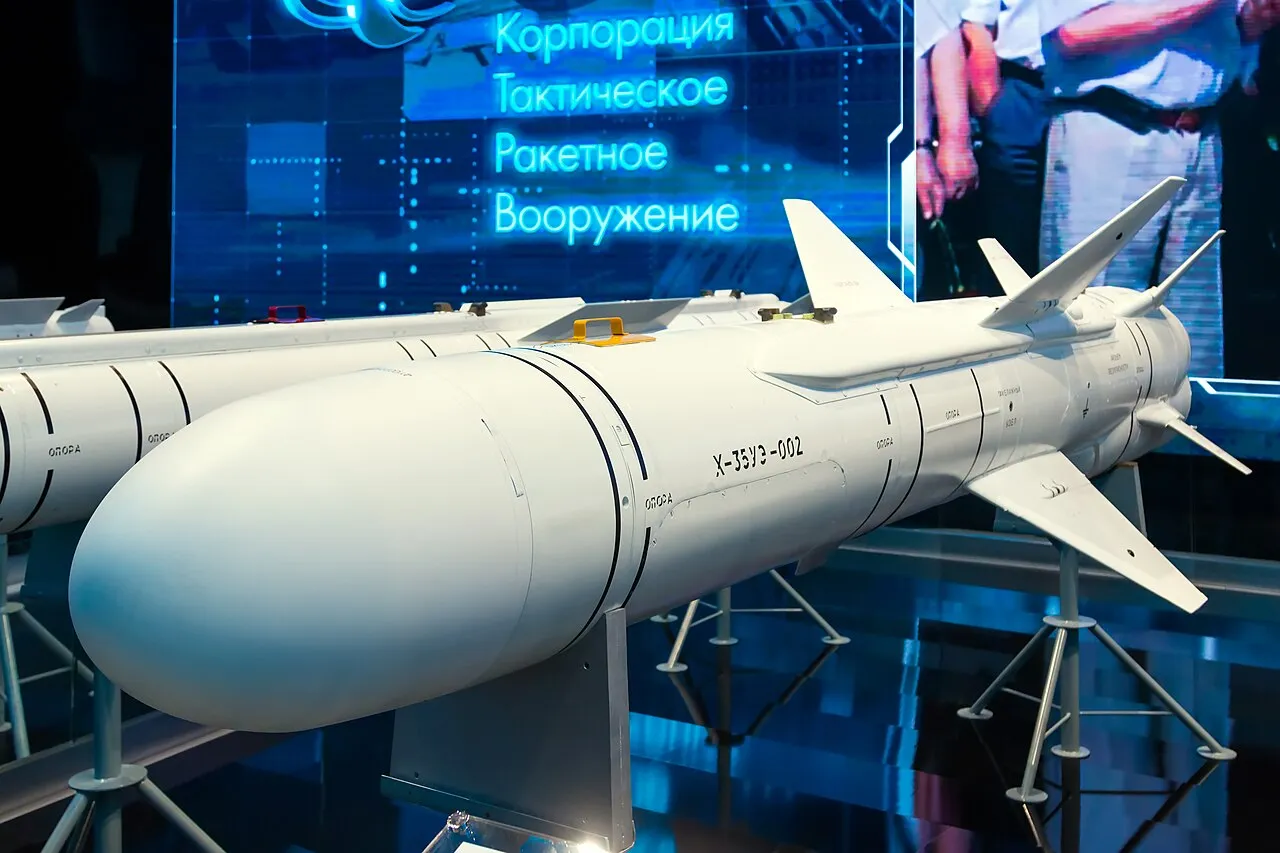
The Kh-35 (Russian Х-35), NATO reporting name AS-20 Kayak, is a Soviet-designed subsonic anti-ship cruise missile1 developed by the Zvezda bureau and built by the Tactical Missiles Corporation. Fired from ships with a rocket booster it is known as Uran (SS-N-25 Switchblade), and from coastal launchers as Bal (SSC-6 Sennight). It is designed to strike vessels of up to 5,000 tonnes2, but Russia has also fired it at land targets in Ukraine. Ukraine’s Air Force reported two Kh-35 guided missiles launched from the Black Sea3 in the night to 5 November 2026.
Design and development
The Soviet Navy wanted a small, cheap, very low-flying missile for frigates and other small warships, an answer to the US Harpoon that earned the informal nickname “Harpoonski”. Work began at Zvezda in 1972 or 1977, depending on the source, and an official go-ahead followed in 1983 to 1984. Test launches from 1985 ran into problems with the miniaturised radar seeker. The missile was shown in 1992, India ordered the export Kh-35E in 1994, and deliveries to the Indian Navy began in 1996, years before the Russian Navy adopted it in 20031. An air-launched version, first made for India’s Il-38SD patrol aircraft, was completed in 2005.
The missile has cruciform wings and fins, a semi-submerged air intake and a turbofan engine. An inertial system steers it to the target area at 10 to 15 m above the sea1, and an active radar seeker takes over near the end, when the missile descends to about 4 m. Ukraine’s own Neptune missile was derived from the Kh-354, TWZ notes.
Specifications
The air-launched missile is 3.85 m long and weighs 520 kg; the ship, coastal and helicopter versions, with their booster, are 4.4 m long and weigh 610 to 620 kg. The body is 42 cm wide, the wings span 1.33 m and the warhead weighs 145 kg. Cruising speed is Mach 0.8 to 0.85. The original Kh-35 reaches 130 km1, and the upgraded Kh-35U, with satellite navigation added, 7 to 260 km.
For the Kh-35U, Defense Express gave in 2023 a length of about 5 m and a launch weight of 670 kg, with the same 145 kg warhead. It added that Russia first claimed a range of 500 km after a 2021 modernisation5, then reported a maximum of 300 km, and called the 500 km figure possibly overstated. One missile has been put at an estimated $500,0001, much cheaper than the Kalibr or Oniks.
Launch platforms
The ship-launched Uran was first meant for Krivak, Gepard and Neustrashimy frigates. A Bal coastal battalion has four launchers with eight missiles each5, up to 32 missiles in one salvo, Defense Express writes. Listed aircraft carriers include the Tu-142 patrol aircraft, the Su-24, the MiG-29M and MiG-29K, the Su-27SM, the Su-30MKI and Su-30SM and India’s HAL Tejas, and helicopters from the Ka-27 to the Ka-52K. Russia’s air force has integrated the Kh-35U1 on the Su-35S and Su-34 since 2014, and Militarnyi wrote that the Kh-35 fired at Kharkiv in June 2025 was presumably launched by a Su-34M6.
Operators and combat use
Vietnam received 340 Kh-35E missiles between 2001 and 20211, and Russia took 112 in 2009 to 2010 and set up Bal brigades on the Black Sea, the Caspian and the Pacific. Algeria, Egypt, Iran and Myanmar are also listed as operators, and North Korea fields a copy, the Kumsong-3. In July 2025 Defense Express wrote that, according to some sources, a new missile seen at a rehearsal for a Vietnamese military parade appears to be based on the Kh-357; citing Defense Blog, it gave the missile variants with a range of 80 to 100 km.
In Ukraine, Russia used Crimea-based Bal systems against Mykolaiv and Odesa in spring and summer 20225, Defense Express wrote, and Ukraine’s National Resistance Center said in June 2023 that a Bal division had moved to Bryansk region. Kharkiv’s regional police chief said a Kh-35 was used in a 20 March 2024 attack that killed five civilians2, although another police official first named a Kh-59. Militarnyi counted at least five strikes on Kharkiv6 itself in 2024, and Ukraine’s Office of the Prosecutor General said a missile identified preliminarily as a Kh-35 struck the city’s Slobidskyi district on 5 June 2025.
Oleksandr Syrskyi, Ukraine’s commander-in-chief, said in August 2024 that of 15 Kh-35s launched, one had been shot down8. In the night to 15 May 2026 the Air Force said it had downed or jammed one Kh-35 launched from occupied Crimea9. Vadym Skibitskyi, deputy head of Ukraine’s military intelligence, said in August 2026 that Kh-35 production had reached 200% of its monthly plan10.
Variants
- Kh-35 (3M24) and Kh-35E: the base Russian naval missile and its export version, delivered from 19961.
- Kh-35U and Kh-35UE: the unified upgrade for any carrier, with satellite navigation and a 50 km seeker range; tests of the export Kh-35UE were completed by June 20211.
- Kh-35UV: a helicopter-launched version for the Ka-52K.
- Bal and Rubezh-ME: the coastal systems; Rubezh-ME is a compact four-missile export version on a Kamaz 8x8 truck.
- Kumsong-3: the North Korean copy, which flew 240 km in a test on 8 June 20171.
- Neptune: Ukraine’s derivative, with a stated range of 300 km4 and differently shaped main fins.
Similar weapons
- Kh-31: a ramjet-powered Russian missile11 with anti-radiation and anti-ship versions, built for sustained supersonic speed, where the Kh-35 is subsonic1.
- P-800 Oniks: a supersonic anti-ship missile, far more expensive than the Kh-351.
- R-360 Neptune: the Ukrainian missile derived from the Kh-354.
- Harpoon: the US anti-ship missile the Kh-35 was developed to answer1.