Contents
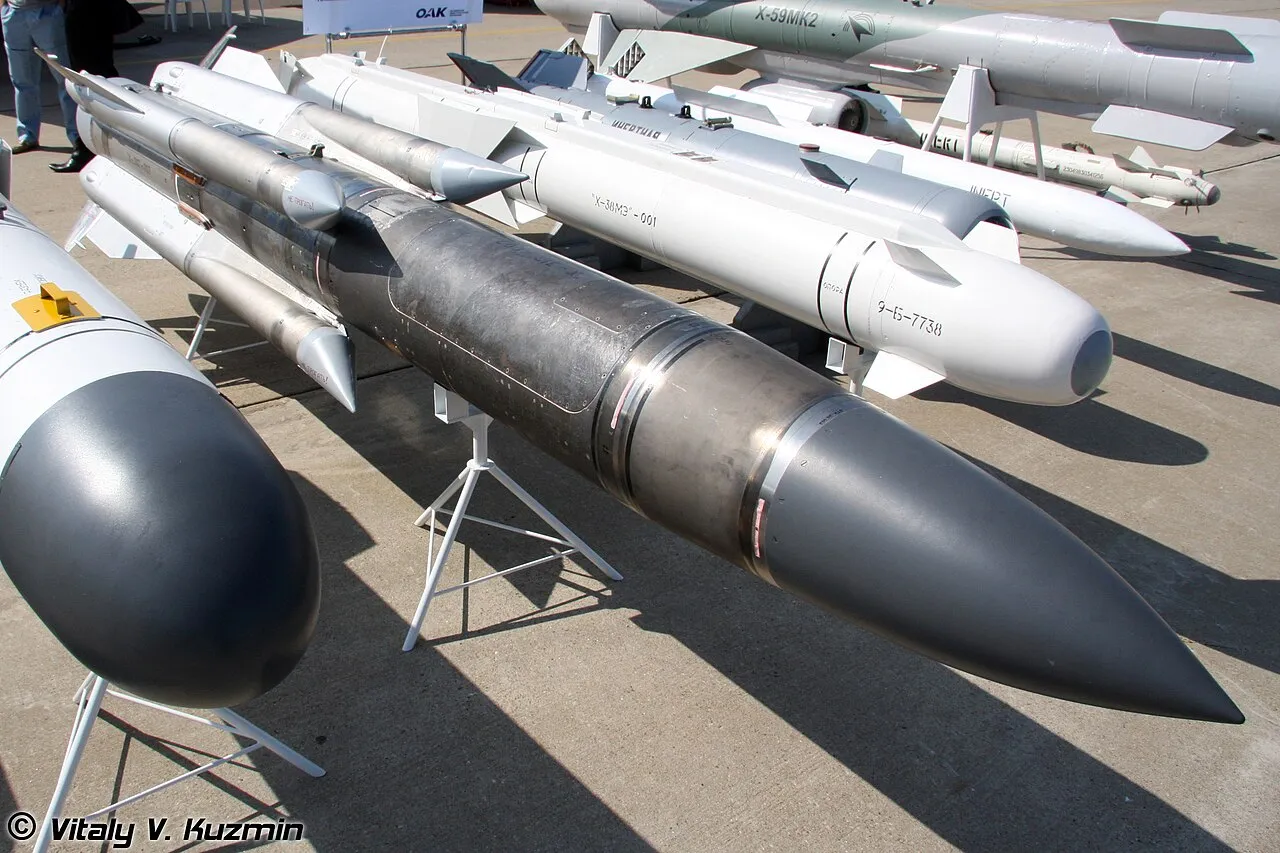
The Kh-31 (Russian Х-31), known to NATO as the AS-17 Krypton, is a Russian-made air-to-surface missile, first developed in the Soviet Union, built in two main forms: the Kh-31P, which homes on the emissions of enemy radars, and the anti-ship Kh-31A. TWZ describes it as a ramjet-powered weapon1 sold in both versions. It was designed by the Zvezda bureau, which was absorbed into the Tactical Missiles Corporation in 20022. Russia fires the Kh-31P at Ukraine, where the Air Force reports it by name in its night summaries: in the night to 26 October 20263 it counted one Kh-31P anti-radiation missile4 among the weapons launched.
Design and development
Work on the family began in the late 1970s. The original requirement was a fast anti-radiation missile against the radars of new Western air defences such as the Patriot and the US Navy’s Aegis1. Zvezda, which had built the Kh-25 family, started work on a long-range one, and the first launch took place in 1982. The anti-radar Kh-31P entered service in 1988 and the anti-ship Kh-31A in 19895. The two versions were first shown in public in 1991, the Kh-31P at Dubai and the Kh-31A at Minsk2.
The missile has been described as a miniaturised version of the P-270 Moskit ship-launched missile, with cruciform titanium wings and control surfaces. A solid-fuel booster in the tail fires first; once it burns out, its empty case serves as the combustion chamber of a kerosene ramjet fed by four air intakes. TWZ gives the booster’s work as accelerating the missile to Mach 1.81, after which the ramjet reaches Mach 3.5 at 53,000 ft, or Mach 1.8 at sea level. The anti-radar seeker of the Kh-31P uses an array of seven spiral antennas2 on a steerable platform.
Specifications
The first-generation Kh-31A is 15 ft 5 in (4.7 m) long1, and the missiles are 36 cm in diameter. The Kh-31P weighs 600 kg at launch and carries an 87 kg warhead, while the Kh-31A weighs 610 kg with a 94 kg penetrating warhead. The Kh-31P has a range of up to 110 km, which Militarnyi also gives5, and both versions have a top speed of 2,160 to 2,520 km/h2.
TWZ gives the anti-ship Kh-31A a range of 9.3 to 31 miles1 (15 to 50 km). The second-generation Kh-31AD and Kh-31PD were lengthened from 4.70 m to 5.3 m2 to increase their range.
Launch platforms
The Kh-31 can be fitted to almost any Russian tactical aircraft2, from the Su-17 to the MiG-31. Listed carriers of both versions include the Su-24M, Su-34 and Su-35, which Militarnyi also names5, as well as the Su-25, the Su-27SM, the Su-30MKI, the MiG-29M and MiG-29K and India’s HAL Tejas, while the Su-33 carries only the Kh-31A. The US Navy launched its MA-31 targets from the F-4 Phantom.
In late January 2026, according to a Telegram channel cited by Militarnyi, Spanish fighters on NATO’s Baltic air policing mission intercepted a Russian Su-30SM2 carrying two Kh-31A missiles and two RBK-500 cluster bombs6.
Operators and combat use
TWZ counts around a dozen operators outside Russia, among them China, India and Vietnam. India bought Kh-31s for its Su-30MKI in 2001 and appears to have bought 60 Kh-31A and 90 Kh-31P2, and listed deliveries include 125 missiles to Algeria in 2007 to 2009 and 222 to Russia in 2009 to 2010. Venezuela received 24 Su-30MK2V fighters between 2006 and 2008; TWZ wrote in October 2025 that the Kh-31A, at least, appears to have been supplied with them, while delivery of the Kh-31P was unclear. In 2025 footage showed Serbian MiG-29s with Kh-31 missiles7 at Batajnica air base, Militarnyi reported, although Serbia had announced no such programme. The United States bought Kh-31s to turn them into anti-ship missile targets1 for testing its warships’ defences.
Some reports say a Russian Su-34 used Kh-31Ps against a Georgian air defense radar near Gori on 10 August 2008. In Ukraine, Militarnyi reported on 9 March 2022 that Ukrainian air defense had shot down a Kh-31P near Berdychiv8 in Zhytomyr region. Russia has used the Kh-31 in its invasion of Ukraine2, and senior Ukrainian Air Force sources said Kh-31P and Kh-58 missiles had destroyed some Osa and Buk air defence systems. In August 2024 Ukraine’s commander-in-chief Oleksandr Syrskyi grouped it with other air-launched missiles: of 1,547 Kh-25, Kh-29, Kh-31, Kh-35, Kh-58, Kh-59 and Kh-60 missiles9 launched since February 2022, he said, 343 had been shot down. In the night to 15 May 2026 the Air Force reported five Kh-31P missiles10 fired from the airspace over the Black Sea, none of which reached its target, and in the night to 26 October 2026 one Kh-31P3 alongside three Kh-59/69 missiles.
Variants
- Kh-31P: the anti-radiation version, offered with three seekers2 for different sets of radars.
- Kh-31A: the anti-ship version with an active radar seeker, for ships of up to 4,500 tonnes2.
- Kh-31PK: an anti-radar missile with a proximity fuze and a range of 120 to 160 km, in serial production since 20092.
- Kh-31AD, Kh-31PD and Kh-31PM: the second generation5; the lengthened Kh-31PD was in serial production by 20122 and the Kh-31AD from 2013, while the Kh-31PM is a modernised Kh-31P with a longer range and a new multi-band seeker.
- MA-31: a US Navy target drone conversion, tested between 1996 and 20072.
- KR-1 and YJ-91: the Kh-31P version sold to China and its Chinese-built derivative2.
Similar weapons
- Kh-35: Zvezda’s subsonic turbojet anti-ship missile11, designed against vessels of up to 5,000 tonnes12, where the Kh-31 family uses a rocket-ramjet for sustained supersonic speeds1.
- Kh-58: Raduga’s earlier anti-radiation missile, in service from 19782 with similar speed and range to the Kh-28 it replaced.
- AGM-88 HARM: an anti-radiation missile that the US supplied to Ukraine in 2022 and that has been fired from upgraded Ukrainian MiG-29s13.